Professional Service
Regrowth Management
Cattail regrowth prevention strategies for California water bodies — post-removal monitoring, early-intervention treatments, and multi-year management programs that keep ponds, lakes, and retention basins clear.
Many California property owners discover the hard way that removing cattails once is not the same as managing them permanently. After a successful initial removal — visible results, cleared water, restored access — the vegetation returns. Sometimes quickly, sometimes after two or three seasons, but it returns. This is not a failure of the removal itself; it is the biological reality of Typha, a plant that evolved specifically to survive disturbance and rapidly recolonize cleared habitat. Effective long-term management means understanding this biology and building a response program that stays ahead of it.
Cattail regrowth after mechanical removal can come from two sources: residual root fragments left in the sediment after extraction, and new seedlings established from wind-dispersed seeds arriving from outside the site. Both require different management responses, and both require monitoring to detect early enough for cost-effective intervention. A site monitored annually and treated when regrowth is at the seedling or early-establishment stage costs a fraction of the cost of re-treating a site that has returned to full infestation.
Understanding Why Cattails Return: The Biology of Regrowth

Cattail rhizomes are among the most resilient root systems of any aquatic plant. A rhizome segment as small as a few inches, left in the sediment after extraction, retains enough stored carbohydrate energy to generate a new stem and begin expanding a new root network within a single growing season. This is why extraction depth and completeness matter so much — every root fragment left behind is a potential regeneration point.
External seed input is the other major regrowth mechanism. Each cattail seed head contains thousands of individual seeds, each attached to a cottony filament that allows wind dispersal across miles. Sites located downwind of established cattail populations — along rivers, canals, or adjacent properties — receive a continuous supply of new seeds every spring. These seeds germinate readily in moist sediment, and if not detected and removed at the seedling stage, establish new plants that begin their own rhizome networks within one growing season.
The combination of residual root regeneration and external seed input means that most sites benefit from annual monitoring, with targeted mechanical removal of any regenerating vegetation before it becomes established. This is the cornerstone of our regrowth management service.
Property Types We Serve for Regrowth Prevention
Our regrowth management programs are appropriate for any water body following initial cattail removal:
- HOA community lakes and ponds following clearing projects
- Municipal stormwater retention basins maintained for compliance
- Agricultural irrigation ponds and tail water basins
- Shoreline and riverbank properties in active revegetation programs
- Golf course water features and aesthetic water bodies
- Nature preserve and restoration sites with managed vegetation programs
- Private estate ponds and water features under ongoing landscape management
Our Regrowth Management Process
Regrowth management begins with baseline documentation of the initial removal project — a photographic record of the cleared site, notes on root extraction completeness, and any areas of the site where complete extraction was difficult. This baseline informs the monitoring program.
Annual monitoring visits are scheduled for late summer or early fall — the end of the growing season — when any regenerating cattails from the current year are identifiable but before new seed heads form and disperse. The monitoring visit includes a systematic assessment of the entire water body perimeter, documentation of any regrowth, and evaluation of regrowth source (root regeneration vs. new seedling establishment).
When regrowth is found during monitoring, we provide an on-the-spot assessment of severity and recommend either targeted mechanical removal during the monitoring visit, or a separate follow-up removal project scheduled for later in the season or the following dormant period. Seedling-stage and early-establishment regrowth is significantly less expensive to remove than mature stands with developed root systems.
Documentation from each annual visit contributes to a regrowth history for the site — tracking trends that inform when more comprehensive re-treatment may be needed and building a maintenance record for HOA and municipal compliance reporting.
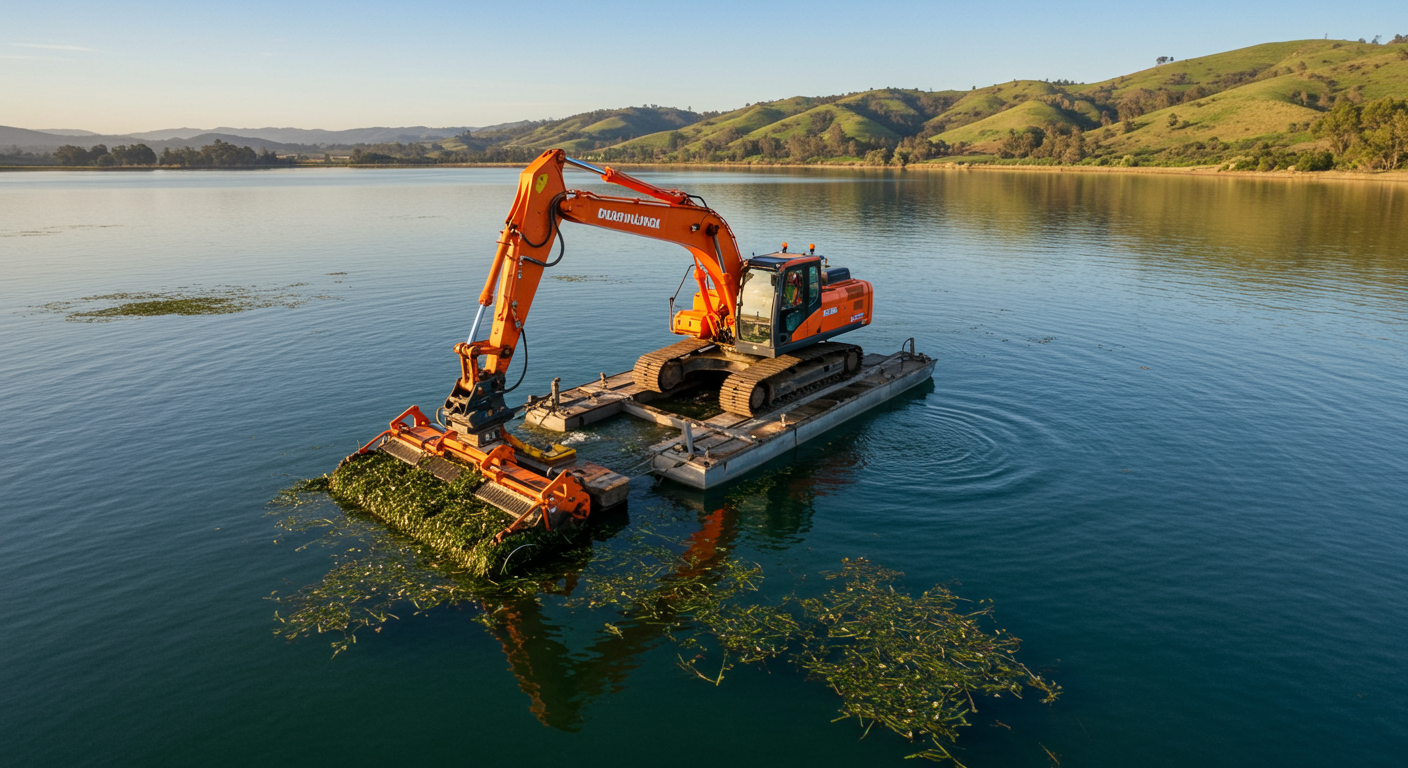
Professional mechanical extraction equipment deployed on California water bodies
Equipment Used in Regrowth Management
Regrowth management visits typically deploy lighter equipment than initial removal projects. Hand tools and pneumatic root extraction equipment handle seedling removal efficiently without requiring full excavator mobilization. For small-scale root regeneration patches, targeted excavation with a mini-excavator or tracked skid steer avoids mobilizing full-size equipment. For any regrowth patches that have advanced beyond early stage, the full excavator equipment suite may be required.
Project Planning Considerations
Timing is the most critical planning factor for regrowth management. Monitoring and treatment at the end of the growing season — August through October in most California locations — targets regenerating vegetation before seed set and prevents the current year's regrowth from contributing to next year's seed bank. Missing this window means waiting another full season for the next treatment opportunity, during which the regrowth continues to develop a larger root system.
Ready for a free on-site evaluation?
Fixed-price quotes. No hourly billing. We serve all of California.
Multi-year programming allows regrowth rates to be tracked over time. Most sites show declining regrowth rates over three to five years as the residual root fragment bank in the sediment is progressively depleted by annual removal. Sites with high external seed input from adjacent populations require ongoing monitoring regardless of how complete the initial extraction was.
Cost Factors for Regrowth Prevention Programs
Annual regrowth management visits are significantly less expensive than initial removal projects. A site that required fifteen thousand dollars for initial removal may cost one thousand to three thousand dollars per year for annual monitoring and targeted regrowth management. Multi-year maintenance agreements provide predictable annual costs and priority scheduling.
The cost-effectiveness of regrowth management is compounded over time: sites managed annually maintain low vegetation levels and low per-visit treatment costs. Sites that go unmanaged for several years between treatments revert to near-original infestation levels, requiring costs comparable to the original removal.
Environmental Considerations
Before & After Results
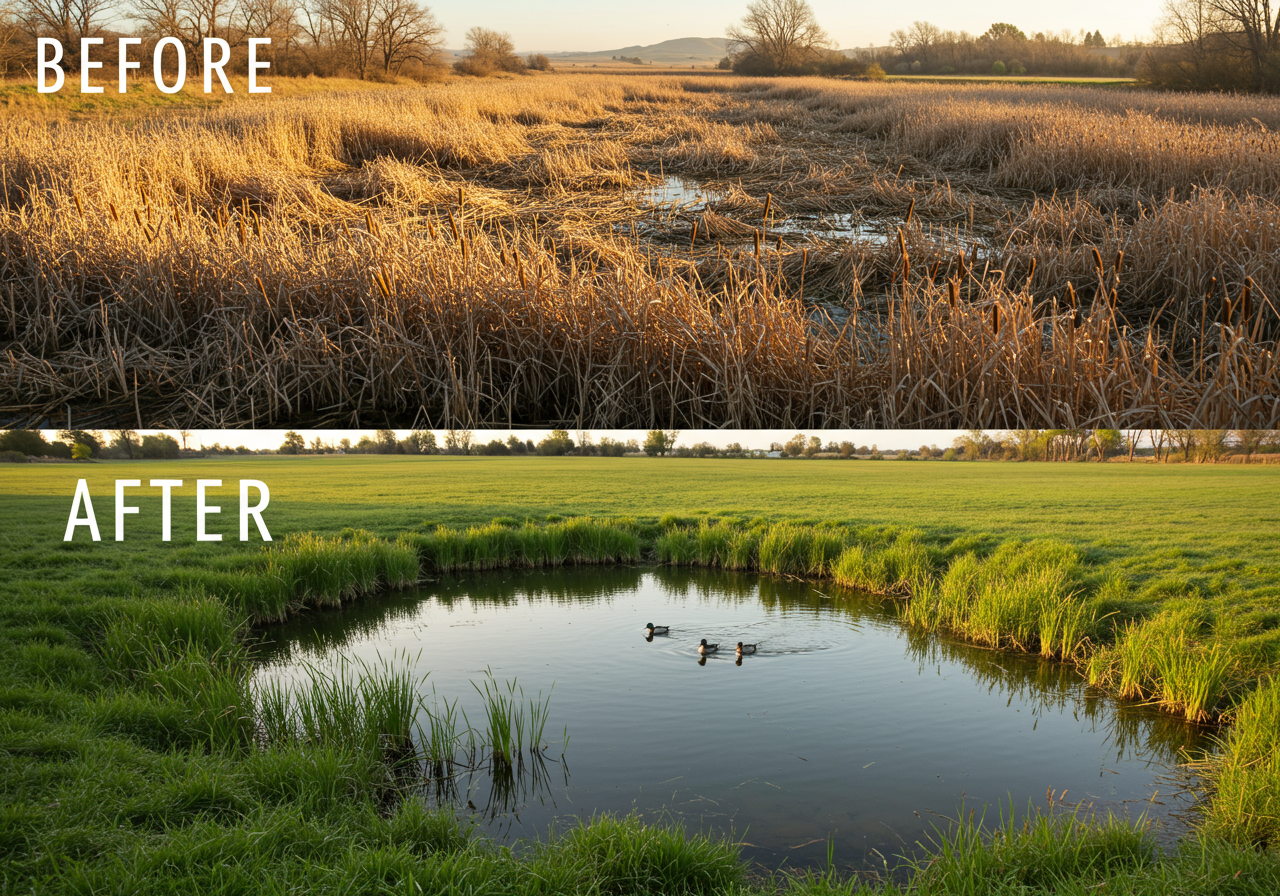
Regrowth management operations are by definition smaller in scale than initial removal and have correspondingly smaller environmental footprints. Targeted removal of seedlings or small regeneration patches involves minimal sediment disturbance and minimal biomass. The overall environmental benefit of preventing full reinfestation — maintaining open water, reducing mosquito habitat, and sustaining native species competition — makes regrowth management programs net positive for water body ecology.
Long-Term Strategies for Sustained Control
Native plant establishment in cleared areas is the single most effective long-term strategy for reducing regrowth rates. Native tule (Schoenoplectus acutus), hardstem bulrush, and spike rush species appropriate to California water bodies compete aggressively with cattail seedlings for the shallow-water niche. Working with a California native plant nursery to establish appropriate species in cleared margins — following each initial removal or major follow-up clearing — builds competitive resistance to recolonization over time.
Water quality management — reducing nutrient input to the water body through buffer strip establishment, reduced fertilizer application, and management of irrigation runoff — lowers the growth rate advantage that cattails enjoy in high-nutrient environments.
Our Inspection and Enrollment Process
Existing clients who have completed an initial removal project can enroll in our regrowth management program by contacting us directly. New clients can initiate services by requesting a site evaluation. The evaluation establishes baseline documentation and develops a monitoring and management schedule tailored to your water body's specific regrowth risk profile.
Frequently Asked Questions
How soon after initial removal do cattails start growing back?
Is annual monitoring worth the cost if my pond looks clear?
Can native plants really compete with cattails?
Do you offer maintenance contracts for Bay Area properties?
What if I only have a small area of regrowth?
Key Service Areas
Our crews are active throughout California. Below are cities, counties, and regional hubs closely served for this service.
Regional Hub
Bay Area Cattail Removal Hub →Related Authority Guides
Ready to solve your cattail problem?
Get a free on-site evaluation and written fixed-price proposal. We serve all of California.
Our Cattail Removal Services
Professional mechanical removal for every California water body type:
Related California Cattail Removal Resources
Further reading on related services, costs, permits, and management strategies for California property owners.
- How to Remove Cattails Permanently
Why rhizome extraction quality is the foundation of any effective California regrowth prevention program.
- Long-Term Cattail Management Plan
A structured multi-year approach to keeping California water bodies clear after initial removal.
- Mechanical Cattail Removal
The extraction technique that makes long-term prevention achievable on California water bodies.
- Best Season for Removal in California
Seasonal timing that improves extraction completeness and reduces regrowth risk in California.
- Habitat Restoration After Removal
Native plant establishment that competes with cattail re-colonization after removal.
- How Fast Do Cattails Spread?
Rhizome expansion rates and seed biology — understanding what drives re-infestation in California.
- Mechanical vs. Herbicide Removal
Why mechanical extraction outperforms herbicide for long-term prevention on most California sites.
California Cities We Serve
Select your city for local pricing and scheduling:
- Los Angeles
- San Diego
- San Jose
- San Francisco
- Sacramento
- Fresno
- Oakland
- Long Beach
- Bakersfield
- Anaheim
- Santa Ana
- Riverside
- Stockton
- Irvine
- Modesto
- Costa Mesa
- Orange
- Huntington Beach
- Santa Barbara
- Ventura
- Santa Rosa
- Salinas
- Chula Vista
- Berkeley
- Pleasanton
- Walnut Creek
- San Mateo
- Palo Alto
- Visalia
- Mission Viejo
- Glendale
- Pasadena
- Torrance
- Pomona
- Corona
- Fontana
- Rancho Cucamonga
- Ontario
- Oceanside
- Escondido
- Carlsbad
- Temecula
- Murrieta
- Victorville
- Burbank
- Fremont
- Hayward
- Concord
- Richmond
- Antioch
- Daly City
- San Leandro
- Redwood City
- Milpitas
- Mountain View
- Sunnyvale
- Santa Clara
- Merced
- Turlock
- Tracy
California Lakes, Deltas & Water Bodies
We serve named water bodies throughout California, including lakes, reservoirs, delta channels, and wetland systems: