Professional Service
Mechanical Cattail Removal
Mechanical cattail removal in California using long-reach excavators and amphibious equipment — root extraction for ponds, lakes, HOA retention basins, Delta channels, and permit-sensitive natural waterways.
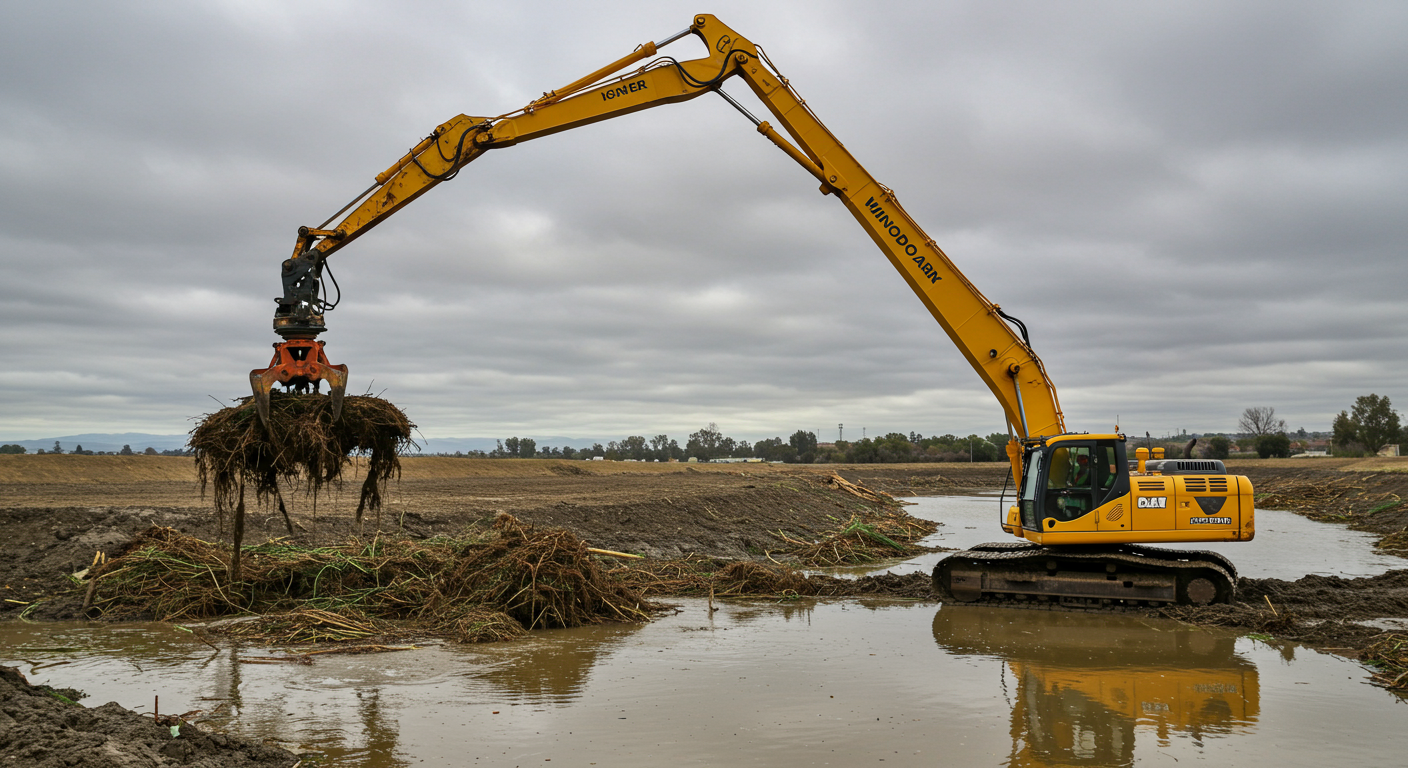
Mechanical cattail removal is the most direct, effective, and durable method available for eliminating established cattail infestations in California water bodies. Unlike surface cutting, which addresses only the visible above-water portion of the plant and triggers aggressive regrowth within weeks, or herbicide treatment, which kills top growth but leaves the root system intact and requires complex permitting, mechanical removal physically extracts the root mass — the rhizome network that sustains and regenerates the plant — from the sediment. When the root mass is gone, the plant cannot grow back from the same location. Regrowth, when it occurs, comes from seed or from minor root fragments, both of which are far more manageable than an established rhizome bank.
California presents conditions that demand mechanical removal on a large scale. The Sacramento-San Joaquin Delta — one of the most productive agricultural and ecological regions in the state — experiences some of the most aggressive cattail growth in North America, driven by the Delta's rich sediment, year-round water, and warm growing season. Agricultural drainage throughout the Central Valley, urban stormwater infrastructure across all major California cities, and thousands of HOA community water bodies across the state all require the same fundamental solution: getting a piece of heavy equipment next to the water and removing the plant at the root.
The Case for Mechanical Over All Alternatives
Mechanical extraction outperforms all alternatives on the most important metrics for most California property types:
Permanence — root extraction produces multi-year results. Surface cutting requires treatment every one to two years. Herbicide rarely achieves complete root kill on established stands.
Chemical-free — mechanical removal leaves no residues in the water column or sediment. No withdrawal periods, no restrictions on irrigated crops, no concerns about downstream chemical transport.
Immediate results — the extraction process removes all visible biomass in the same operation. No dead material left to decompose in the water body.
Regulatory simplicity — most mechanical extraction projects have far simpler permit requirements than aquatic herbicide applications, which require county permits, licensed applicators, and RWQCB compliance.
Versatility — mechanical equipment can address any infestation size, from a small HOA retention pond to a multi-acre Delta channel, by scaling the equipment type and project duration.
Overview of the Cattail Infestation Challenge
Established cattail stands in California range from thin, recently-established fringes at the margins of previously-clear water bodies to dense, multi-year accumulations where the root mat has built up to eighteen to thirty-six inches of depth in the sediment. The age and density of the root mat is the primary determinant of project complexity and cost — and the primary reason why early intervention produces better results at lower cost than waiting for full establishment.
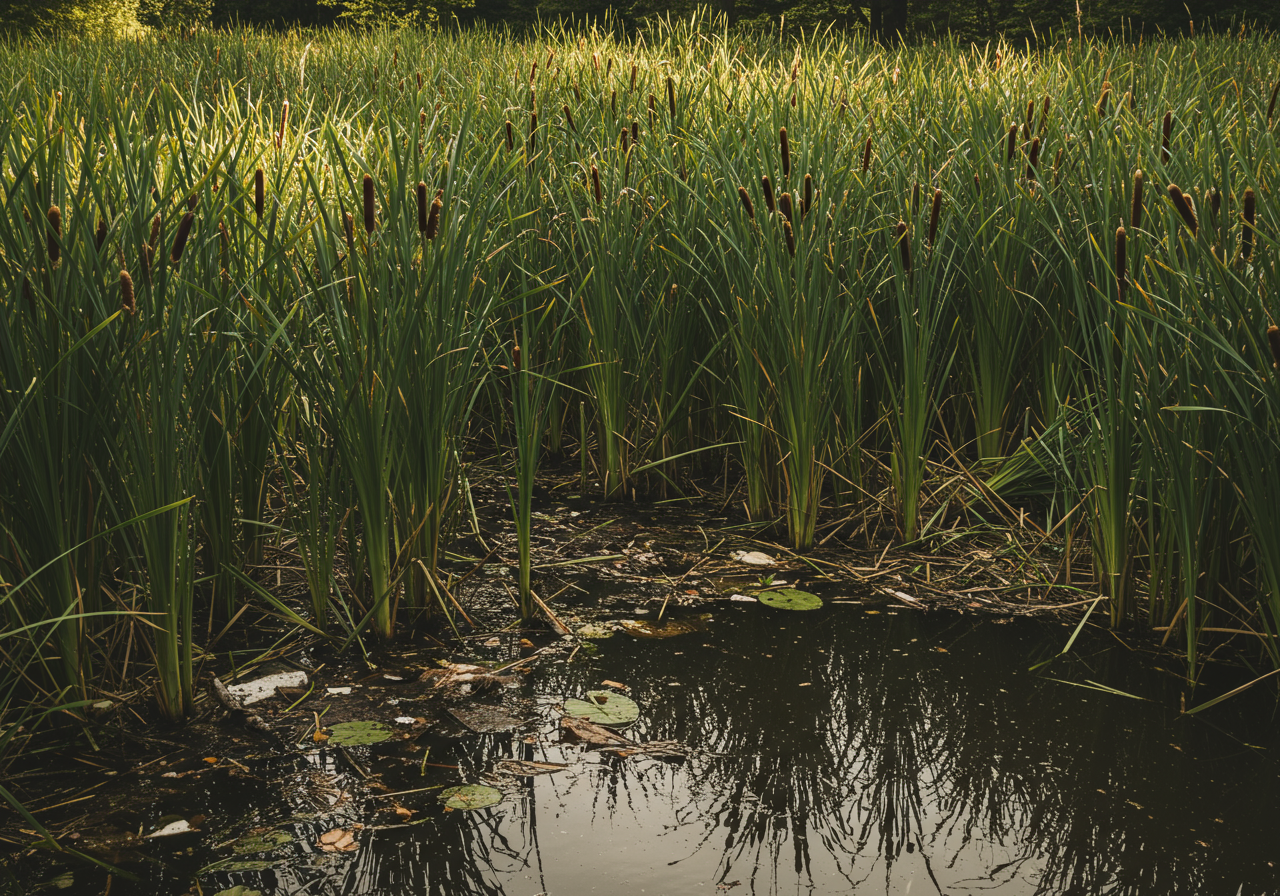
Typha root systems are engineered by biology for survival. The rhizome network spreads horizontally through the sediment at up to one meter per year from each active growing front. Root nodes can remain viable in saturated sediment for multiple years even if the above-water portions are removed. The root mat acts as a growing platform that rises slightly above the surrounding sediment, advancing into open water season over season. Once a root mat achieves sufficient density and elevation, it begins to trap wind-blown debris and sediment, accelerating the transition from shallow water to vegetated wetland.
Property Types Served with Mechanical Removal
Our mechanical removal equipment is deployed across the full range of California water body types:
- Agricultural drainage basins and tail water ponds throughout the Central Valley
- Municipal and HOA stormwater retention infrastructure across all California cities
- Delta channel and levee-adjacent vegetation management in the Sacramento-San Joaquin Delta
- Golf course and resort water features
- Natural lake and reservoir shorelines with maintenance access
- Irrigation canal banks and canal-adjacent ponds
- Private agricultural and ranch ponds
- Riparian corridor restoration sites
Our Mechanical Removal Process in Detail
Phase 1 — Site evaluation and mobilization planning. We assess the target vegetation area, determine appropriate equipment type and access routes, and develop a mobilization and work plan. For projects requiring amphibious equipment, we confirm launch ramp locations, water depth along travel routes, and any navigation restrictions.
Phase 2 — Equipment deployment. Shore-based excavators are positioned at bank access points. Amphibious units are launched and navigated to the work area. All equipment is checked for operational readiness before active extraction begins.
Phase 3 — Rhizome extraction. The excavator bucket penetrates the sediment to the required depth — typically twelve to twenty-four inches for HOA and agricultural pond applications, up to thirty-six inches for mature Delta and marshland root mats. Root masses are extracted in sections, lifted clear of the water, and deposited on the bank or barge for dewatering.
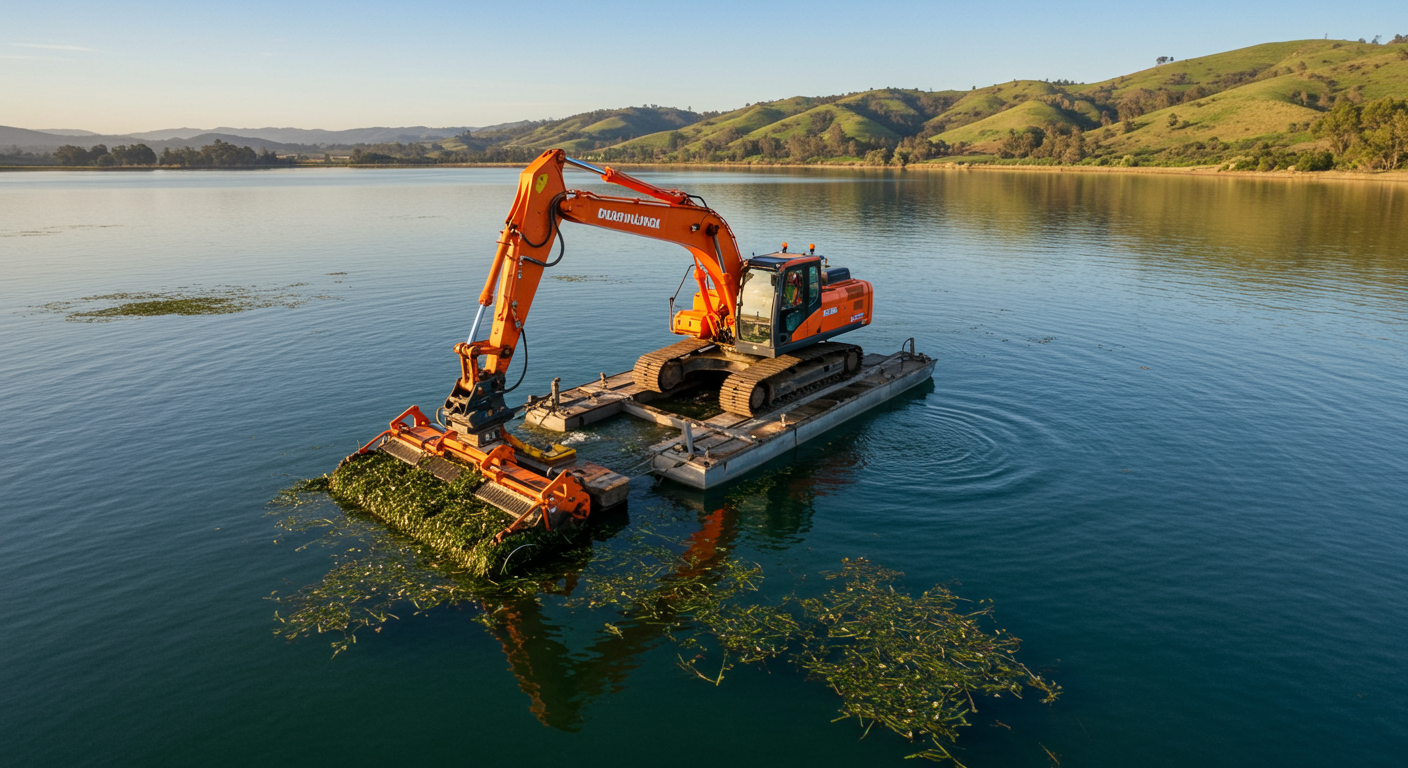
Professional mechanical extraction equipment deployed on California water bodies
Phase 4 — Biomass staging and hauling. Extracted biomass is staged at bank-side or barge-transported to staging areas. After twenty-four to forty-eight hours of dewatering, the material is loaded and hauled to approved disposal or composting facilities.
Phase 5 — Site documentation and close-out. Post-project photographs document cleared areas. Written project summary is provided on request for compliance and maintenance records.
Equipment Suite for Mechanical Removal
Long-reach shore excavators with forty to sixty-foot boom extensions handle the majority of California mechanical removal projects. Operating from stable bank positions, these machines combine strong hydraulic extraction force with the reach to access vegetation fifteen to twenty feet from the bank — sufficient for most HOA ponds, retention basins, and agricultural pond margins.
Amphibious excavators on sealed pontoon floats are used when the work site cannot be reached from the shore — open-water Delta channels, large lake centers, soft-bank wetlands, or any site where the vegetation extends beyond reach of shore-based equipment. These machines navigate on open water and exert full excavation force for root extraction.
Ready for a free on-site evaluation?
Fixed-price quotes. No hourly billing. We serve all of California.
Hydraulic root rakes and thumb attachments improve extraction efficiency when working through dense, tangled root mats, allowing the operator to grip and strip rhizome sections more effectively than with a standard bucket.
Barge and work boat support is used on large-scale Delta and lake projects to transport extracted biomass from the work zone to bank-side staging areas, eliminating the need to navigate the amphibious excavator over long distances during disposal operations.
Planning Considerations for Mechanical Projects
Equipment access is the first planning variable — every mechanical project begins by identifying how to get equipment to the water. This may be straightforward (a service road along a basin perimeter) or complex (a remote agricultural pond with no vehicle access). Remote access situations require additional mobilization planning — track excavators can move overland where vehicles cannot, and amphibious units can be deployed by water.
Project phasing may be appropriate for large sites where clearing the entire area in a single mobilization would be cost-prohibitive. Prioritizing the most operationally critical areas (inlet and outlet zones, recreational frontage, visible areas near structures) in the first phase, with secondary areas addressed in subsequent seasons, allows a large project to be managed within annual budget constraints.
Cost Factors for Mechanical Removal Projects
Project cost is primarily determined by vegetation volume (which drives equipment time), equipment type required (shore-based is less expensive than amphibious), and site access conditions (mobilization cost varies with site remoteness). Most California mechanical removal projects fall into one of these ranges:
Before & After Results

HOA pond or retention basin (accessible bank, standard conditions): $25,000–$50,000 per acre.
Agricultural or larger HOA pond (moderate to high density, road access): $35,000–$70,000 per acre.
Large lake or reservoir shoreline clearing: $50,000–$100,000 per acre depending on water depth and biomass volume.
Delta channel and wetland projects: $60,000–$100,000 per acre with waterborne mobilization premiums for remote access.
Environmental Considerations for Mechanical Projects
Mechanical extraction is environmentally clean compared to chemical alternatives. The primary environmental consideration is temporary sediment turbidity during and immediately after extraction — a natural, self-resolving condition. No chemical residues are introduced; no dead biomass decomposes in the water column; no withdrawal periods restrict subsequent water use.
We time projects to avoid known fish spawning periods and bird nesting seasons where applicable, and coordinate with CDFW for any work in regulated natural waterways.
Long-Term Management After Mechanical Removal
Mechanical removal is most cost-effective as part of a long-term management program. The initial project eliminates the primary root mass; annual monitoring and early-intervention follow-up addresses any regrowth before it re-establishes. Most sites treated to full root extraction require only minor follow-up work for three to five years after the initial project, producing a total multi-year cost significantly below the cost of repeated partial treatments that never resolve the underlying root mass.
Our Inspection and Proposal Process
Contact us to schedule a free site evaluation. We assess your water body, develop an equipment and work plan tailored to your site, and provide a fixed-price written proposal within twenty-four to forty-eight hours of the evaluation. We serve the full California Central Valley, Bay Area, Northern California, and Southern California.
Frequently Asked Questions
Is mechanical removal always the best choice for cattails in California?
How deep does the excavator need to go to remove the roots?
Can you do mechanical removal in a pond or lake that is still full of water?
What Central Valley and Northern California cities do you serve?
How does your company handle biomass disposal after removal?
Key Service Areas
Our crews are active throughout California. Below are cities, counties, and regional hubs closely served for this service.
Regional Hub
Northern California Cattail Removal Hub →Related Authority Guides
Ready to solve your cattail problem?
Get a free on-site evaluation and written fixed-price proposal. We serve all of California.
Our Cattail Removal Services
Professional mechanical removal for every California water body type:
Related California Cattail Removal Resources
Further reading on related services, costs, permits, and management strategies for California property owners.
- Pond Cattail Removal
Mechanical extraction for private ponds, farm ponds, and ranch water features across California.
- Lake Edge Clearing
Shore-based and amphibious mechanical removal for California lake shorelines and reservoir margins.
- Retention Basin Clearing
HOA, municipal, and commercial stormwater basin clearing using shore-based excavators.
- Amphibious Excavator Removal
When open-water or soft-bottom conditions require waterborne equipment for root extraction.
- How to Remove Cattails Permanently
Why full rhizome extraction produces lasting results where surface cutting always fails.
- Best Season for Removal in California
Fall and winter scheduling windows that improve access and reduce project costs in California.
- Equipment Mobilization Cost
How remote site access and equipment transport affect mechanical project pricing across California.
- Municipal Cattail Removal
Scaling mechanical extraction to California public agency projects — multi-basin programs, procurement documentation, and phased scheduling for city and county operators.
- Stormwater Basin Cattail Maintenance
Applying mechanical root extraction in recurring annual maintenance programs for California HOA and municipal stormwater detention basins.
- Cattail Disposal and Haul-Off
How extracted biomass is staged, loaded, and transported after mechanical removal — haul-off logistics for California water body projects of all sizes.
- Irrigation Pond Cattail Removal
Mechanical extraction on California agricultural irrigation ponds — protecting pump intakes and scheduling around the agricultural calendar.
California Cities We Serve
Select your city for local pricing and scheduling:
- Los Angeles
- San Diego
- San Jose
- San Francisco
- Sacramento
- Fresno
- Oakland
- Long Beach
- Bakersfield
- Anaheim
- Santa Ana
- Riverside
- Stockton
- Irvine
- Modesto
- Costa Mesa
- Orange
- Huntington Beach
- Santa Barbara
- Ventura
- Santa Rosa
- Salinas
- Chula Vista
- Berkeley
- Pleasanton
- Walnut Creek
- San Mateo
- Palo Alto
- Visalia
- Mission Viejo
- Glendale
- Pasadena
- Torrance
- Pomona
- Corona
- Fontana
- Rancho Cucamonga
- Ontario
- Oceanside
- Escondido
- Carlsbad
- Temecula
- Murrieta
- Victorville
- Burbank
- Fremont
- Hayward
- Concord
- Richmond
- Antioch
- Daly City
- San Leandro
- Redwood City
- Milpitas
- Mountain View
- Sunnyvale
- Santa Clara
- Merced
- Turlock
- Tracy
California Lakes, Deltas & Water Bodies
We serve named water bodies throughout California, including lakes, reservoirs, delta channels, and wetland systems: