Professional Service
Pond Cattail Removal
Professional pond cattail removal in California — mechanical root extraction for private ponds, farm ponds, golf course water features, HOA ponds, and ranch water bodies. Free site evaluations statewide.
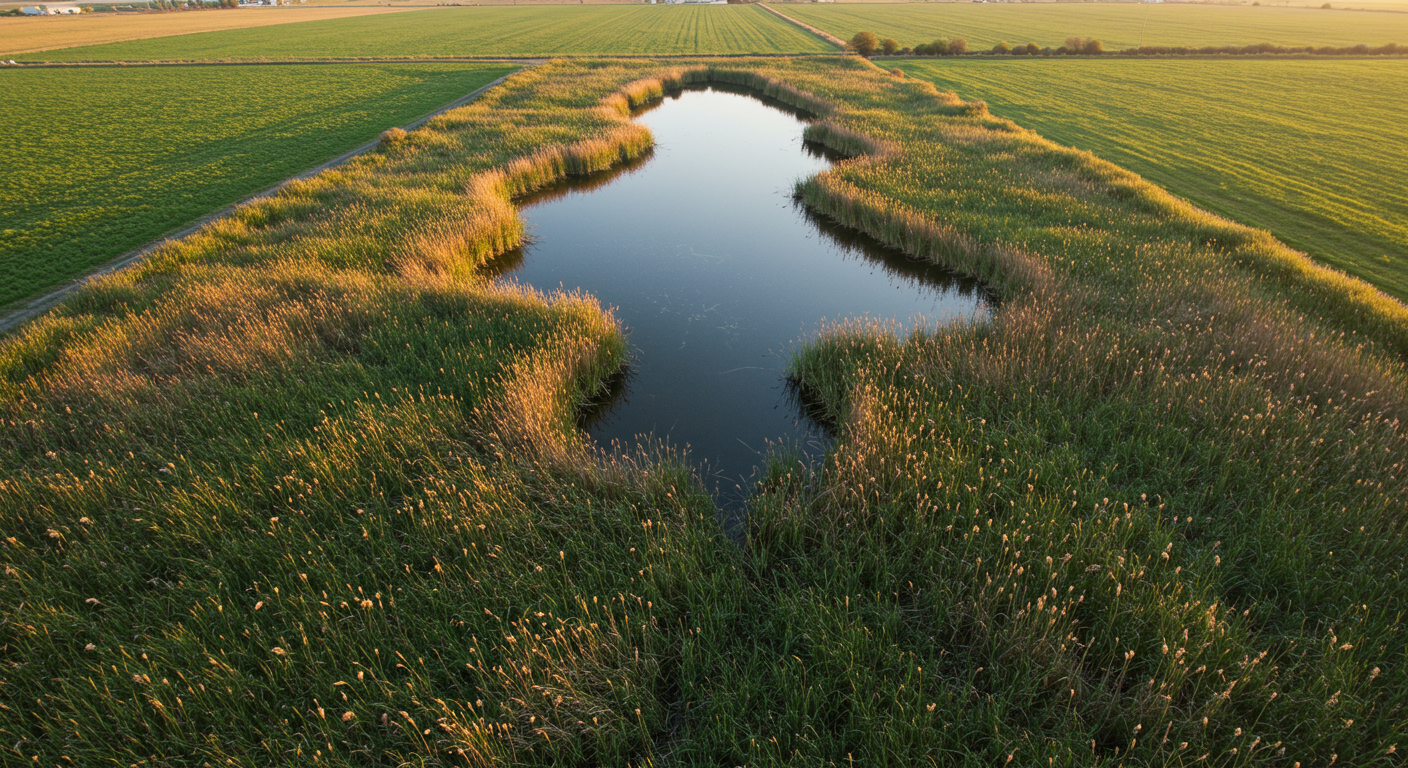
California ponds — whether private residential water features, HOA community amenity lakes, or working agricultural ponds — share one persistent problem: cattails invade early, spread aggressively, and return rapidly unless the root mass is completely removed. A single mature cattail plant produces thousands of wind-dispersed seeds each season and extends its rhizome network up to ten feet in every direction through the pond sediment. Within two to four growing seasons, a small fringe of cattails along one bank becomes an impenetrable wall of vegetation that consumes the entire shallow perimeter of the pond.
The consequences of unchecked cattail growth in a pond are significant. Open water surface area shrinks as the vegetated zone expands. Oxygen levels in the water column decline as decaying biomass builds up in the sediment. Mosquito populations explode in the stagnant water trapped within dense cattail stands. For HOA communities, overgrown ponds trigger resident complaints and may constitute a governing document violation. For agricultural operators, blocked irrigation inlets and reduced storage volume directly reduce the functional value of the asset.
Why Ponds Are Particularly Vulnerable to Cattail Invasion
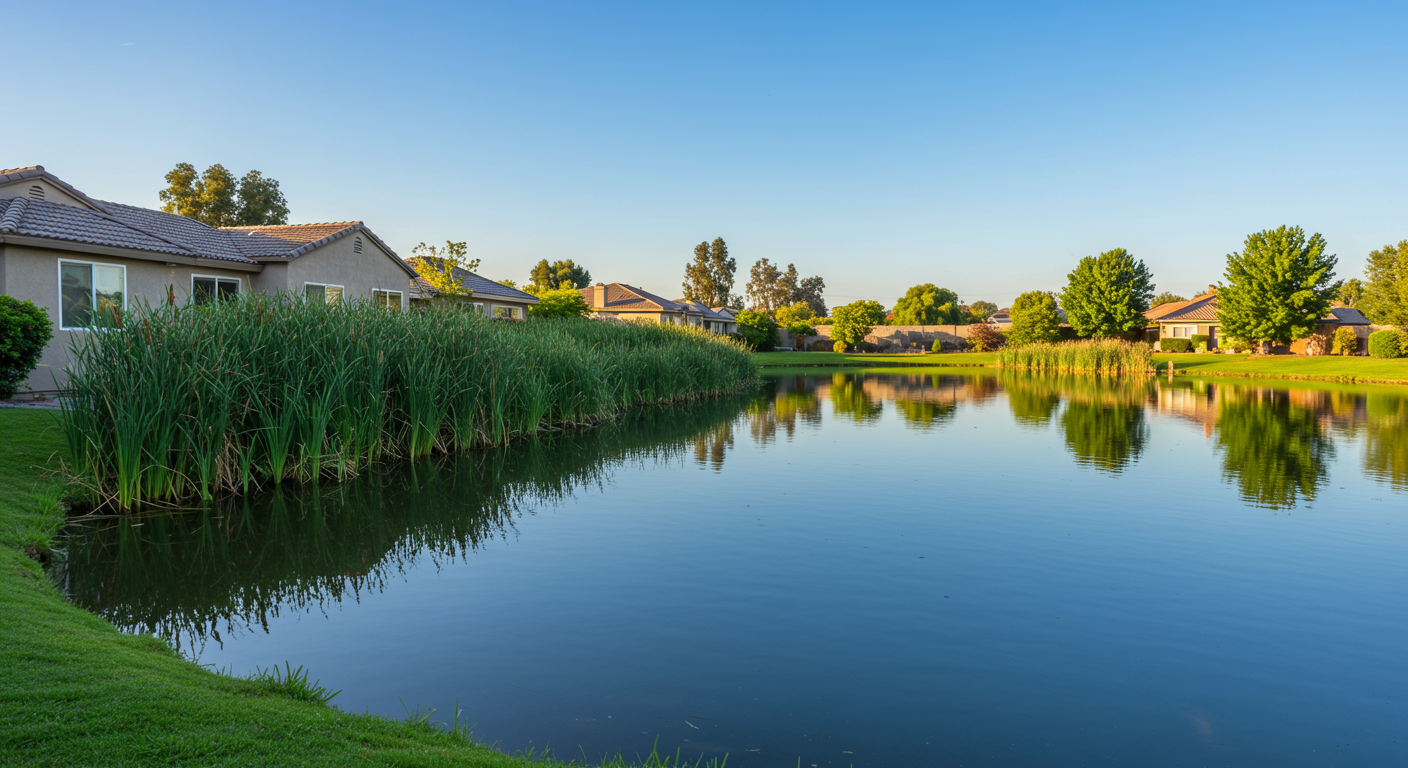
Ponds occupy a unique position in the cattail invasion landscape because of their combination of shallow margins, still water, and — in most California landscapes — consistently nutrient-rich water. HOA ponds receive runoff from lawns and landscaping that brings phosphorus and nitrogen, the two nutrients that drive the fastest cattail growth. Agricultural ponds receive water from irrigation return flows and field runoff that are similarly enriched. Even private ornamental ponds in well-kept estates can experience rapid Typha colonization if the pond has any shallow areas where cattail seeds can establish in the sediment.
The pond's still or slow-moving water is also critical. Unlike streams and rivers where current can limit colonization, ponds create the perfect still-water environment for cattail rhizomes to spread uninhibited. Once a root mat establishes in the shallow margins, the plant draws water from the pond itself and can continue to expand even during summer months when surface water levels drop.
Property Types We Serve Across California
Our pond cattail removal services address the full range of pond property types found across California:
- Private residential ponds and water gardens with ornamental features
- HOA-managed community ponds and amenity lakes up to five acres
- Agricultural irrigation ponds, tail water recovery basins, and on-farm storage
- Golf course water hazards and aesthetic water features
- Commercial property ornamental ponds and retention features
- Winery estate ponds and ranch water sources
- Municipal park ponds and recreational fishing water bodies
Our Pond Removal Process Step by Step
Every pond project begins with a free on-site evaluation where we assess the pond's size, water depth, bank accessibility, vegetation density, and sediment conditions. This evaluation determines the appropriate equipment and approach for your specific pond.
Following the evaluation, we provide a written fixed-price proposal that covers all phases of work: mobilization, mechanical extraction, biomass staging and dewatering, hauling and disposal, and any site cleanup. There are no hourly billing surprises — your quote is your project cost.
Mechanical extraction is the core of our process. Depending on the pond's characteristics, we deploy either shore-based long-reach excavators or amphibious equipment capable of operating in the water itself. The excavator bucket penetrates the sediment to twelve to twenty-four inches — the depth where the primary rhizome layer lives — and physically extracts the root mat in sections. Extracted biomass is deposited on the bank to dewater before hauling. Most pond projects are completed within one to three days, and the water clears of turbidity within twenty-four to seventy-two hours of project completion.
Equipment Deployed for Pond Cattail Removal
The equipment we deploy for pond work depends on the pond's size, depth, and bank conditions:
Long-reach excavators with forty to sixty-foot arms are the most cost-effective option for ponds where the vegetation is within reach of a stable, accessible bank. These machines provide strong digging force and can extract deep root mats efficiently.
Amphibious excavators mounted on sealed pontoon floats are used when ponds are too deep, too wide, or have banks too soft or steep to support conventional equipment. These machines float and maneuver on open water, giving us access to any area of the pond regardless of shore conditions.
Aquatic weed harvesters may be used in conjunction with excavation for cutting and clearing floating vegetation or surface growth prior to root extraction.
Project Planning Considerations for California Ponds
Several factors affect how a pond removal project is planned and scheduled:
Basin drawdown — if you can lower the water level before work begins, root access improves and project cost typically decreases. We advise on whether drawdown is feasible for your specific pond.
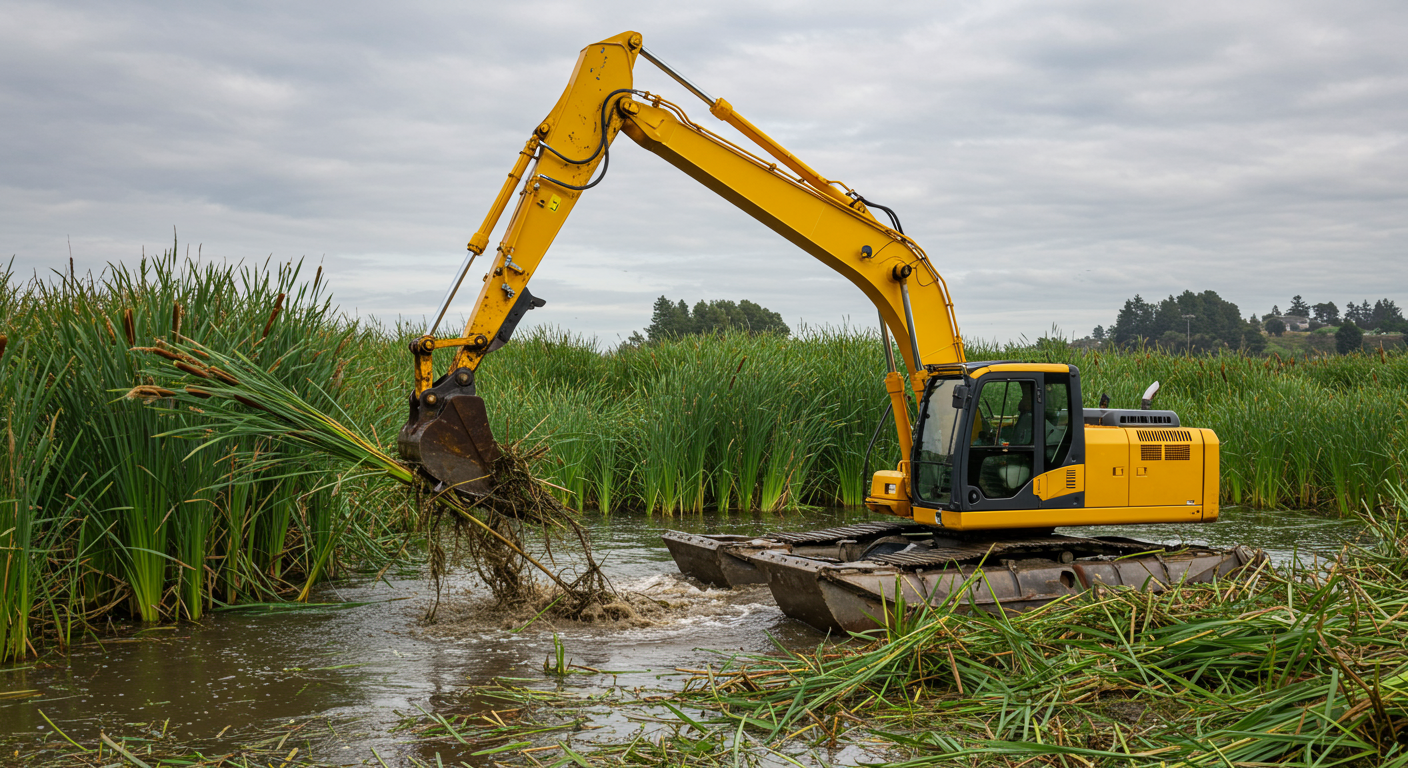
Professional mechanical extraction equipment deployed on California water bodies
Seasonal timing — fall and winter are optimal for most California pond projects. Late-season work benefits from lower water levels and dormant vegetation, while spring projects face fully mature root mats at maximum water levels.
Permit requirements — most private and HOA ponds in engineered or lined systems require minimal or no permits. Agricultural ponds and any water body connecting to natural waterways may require coordination with California regulatory agencies. We assess permit needs during the site evaluation.
Wildlife considerations — if the pond is used by nesting birds or known fish species, project timing may need to accommodate nesting season avoidance requirements.
Cost Factors for Pond Cattail Removal
The cost of a pond removal project depends on five primary variables:
Vegetation density and depth of root mat — a recent infestation with shallow roots costs significantly less to remove than a decade-old stand with root mats extending twenty-four inches into the sediment.
Ready for a free on-site evaluation?
Fixed-price quotes. No hourly billing. We serve all of California.
Pond size and water conditions — larger ponds with deeper water require more equipment time and may require amphibious rather than shore-based machinery, adding to project cost.
Site access — remote agricultural ponds with limited road access or no vehicle route to the water's edge require additional mobilization planning and cost.
Biomass disposal — heavy, wet cattail root mats can weigh several tons per acre. Hauling and disposal of biomass is included in all our quotes.
Permit requirements — if your pond requires regulatory permits, associated filing fees and environmental documentation add to overall project cost.
Environmental Considerations for Pond Removal
Mechanical cattail removal from ponds has minimal environmental impact when performed by experienced operators. The primary environmental consideration is temporary water turbidity from sediment disturbance during extraction. This turbidity clears naturally within twenty-four to seventy-two hours and does not cause lasting harm to water quality.
We do not use herbicides in our pond removal work. Chemical treatments create withdrawal periods that restrict irrigation use, are restricted near food crops, and require county pesticide permits and licensed applicators. Mechanical extraction provides clean, chemical-free results appropriate for all pond types including those used for agricultural irrigation.
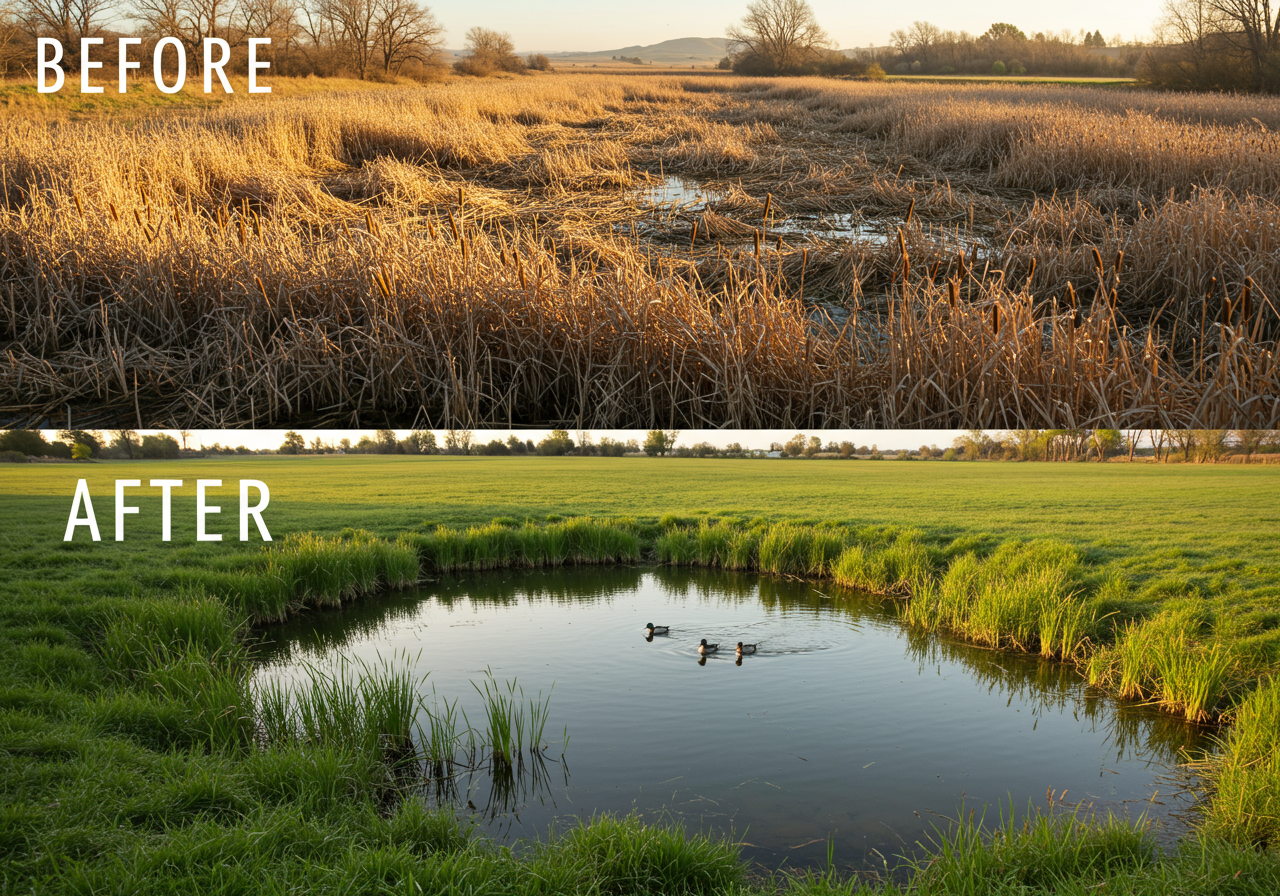
Before & After Results
For ponds with known wildlife habitat value, we can schedule work to avoid sensitive seasonal windows including bird nesting periods and fish spawning seasons specific to your water body.
Long-Term Management Strategies for California Ponds
A single comprehensive mechanical removal provides three to five years of significantly reduced vegetation burden in most California ponds. To maximize this benefit and prevent return to pre-treatment conditions, we recommend:
Annual monitoring visits — a single site visit each fall to assess any regrowth before it becomes established. Early intervention on seedling regrowth or minor rhizome regeneration is dramatically less expensive than allowing full re-establishment.
Native plant establishment — introducing native rush, sedge, and tulle species along the cleared margins helps occupy the ecological niche that cattails would otherwise refill. Established native vegetation actively competes with cattail seedlings.
Water quality management — reducing nutrient inputs to the pond by managing irrigation runoff, minimizing fertilizer application near the pond bank, and installing buffer zones of native grasses reduces the growth conditions that drive cattail invasion.
Our Inspection Process
Scheduling begins with a phone call or online request. We confirm your location, pond size, and access conditions, then schedule a free on-site evaluation at a time convenient for you. During the evaluation, we walk the site with you, assess vegetation density and coverage, probe sediment depth, evaluate bank stability, and review any permit considerations specific to your property. You receive a written proposal within twenty-four to forty-eight hours of the evaluation, and can schedule work at your convenience once the proposal is accepted.
Frequently Asked Questions
How long does pond cattail removal take?
Will the water be disturbed during removal?
Can you remove cattails from a pond that is currently in use for irrigation?
Do you haul away all the vegetation?
What cities do you serve for pond removal in the Central Valley?
Key Service Areas
Our crews are active throughout California. Below are cities, counties, and regional hubs closely served for this service.
Counties
Regional Hub
Central Valley Cattail Removal Hub →Related Authority Guides
Ready to solve your cattail problem?
Get a free on-site evaluation and written fixed-price proposal. We serve all of California.
Our Cattail Removal Services
Professional mechanical removal for every California water body type:
Related California Cattail Removal Resources
Further reading on related services, costs, permits, and management strategies for California property owners.
- Lake Edge Clearing
Mechanical removal for larger water bodies — community lakes, reservoir shorelines, and golf course lakes.
- Mechanical Cattail Removal
The root extraction process used on all California pond and water body projects.
- Pond Removal Cost Estimator
Size, density, and access factors that determine private or farm pond project costs in California.
- How to Remove Cattails Permanently
Why full rhizome extraction is necessary for lasting results on California ponds.
- Cattail Regrowth Prevention
Post-removal strategies to suppress re-colonization and protect your pond long-term.
- Best Season for Removal in California
Fall scheduling for California ponds often means lower water levels and better equipment access.
- California Permit Considerations
Private pond permit requirements — when you need regulatory coordination and when you don't.
- HOA Pond Cattail Removal
Specialized removal for California HOA-managed community ponds — recurring service programs and board-ready compliance documentation.
- Golf Course Pond Cattail Removal
Clearing water hazards and irrigation ponds on California golf courses with minimal disruption to course operations and turf.
- Irrigation Pond Cattail Removal
Protecting pump intakes and restoring storage capacity on California agricultural irrigation ponds, tail water basins, and farm ponds.
- Cattails and Mosquito Control
How pond cattail stands create stagnant breeding zones — and what root extraction does to eliminate recurring mosquito pressure on California properties.
- Cattail Disposal and Haul-Off
Managing extracted biomass after pond clearing — haul-off logistics, composting options, and how disposal affects project timelines and costs.
California Cities We Serve
Select your city for local pricing and scheduling:
- Los Angeles
- San Diego
- San Jose
- San Francisco
- Sacramento
- Fresno
- Oakland
- Long Beach
- Bakersfield
- Anaheim
- Santa Ana
- Riverside
- Stockton
- Irvine
- Modesto
- Costa Mesa
- Orange
- Huntington Beach
- Santa Barbara
- Ventura
- Santa Rosa
- Salinas
- Chula Vista
- Berkeley
- Pleasanton
- Walnut Creek
- San Mateo
- Palo Alto
- Visalia
- Mission Viejo
- Glendale
- Pasadena
- Torrance
- Pomona
- Corona
- Fontana
- Rancho Cucamonga
- Ontario
- Oceanside
- Escondido
- Carlsbad
- Temecula
- Murrieta
- Victorville
- Burbank
- Fremont
- Hayward
- Concord
- Richmond
- Antioch
- Daly City
- San Leandro
- Redwood City
- Milpitas
- Mountain View
- Sunnyvale
- Santa Clara
- Merced
- Turlock
- Tracy
California Lakes, Deltas & Water Bodies
We serve named water bodies throughout California, including lakes, reservoirs, delta channels, and wetland systems: