Professional Service
Retention Basin Clearing
Retention basin cattail removal for California HOA communities, municipalities, and commercial properties — mechanical extraction that restores stormwater detention capacity and maintains MS4 permit compliance.
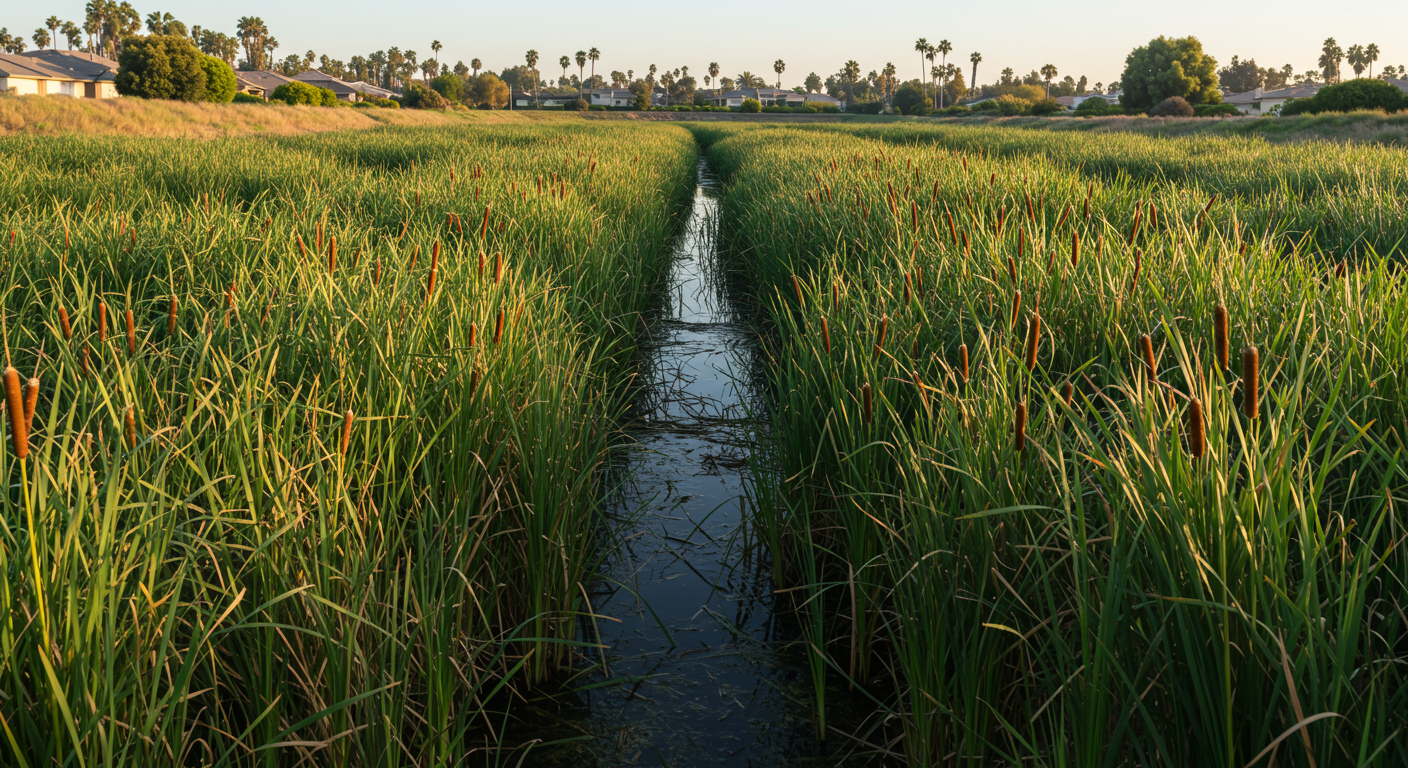
Retention basins are the engineered backbone of California's urban stormwater management infrastructure — holding stormwater runoff during rain events, allowing sedimentation and partial treatment to occur, and releasing flow in a controlled manner to protect downstream waterways and communities from flooding. When cattails colonize a retention basin, the consequences extend far beyond aesthetics. Reduced detention volume means less capacity to capture and hold runoff during storm events. Vegetated areas trap debris and create clogging risk at outlet structures. Dense cattail stands create the stagnant, standing-water conditions that Aedes and Culex mosquitoes exploit as breeding habitat — a public health concern in densely populated communities. Municipalities with MS4 stormwater permits face compliance exposure when basin capacity falls below design thresholds.
Retention basin cattail management is fundamentally different from other aquatic vegetation removal because of the compliance dimension. HOA boards, municipal public works departments, and commercial property managers are not simply managing aesthetics — they are maintaining infrastructure that must function to regulatory specification. Our retention basin clearing services are designed to restore compliant basin function, document the work properly, and provide the maintenance record that satisfies regulatory reporting requirements.
Why Retention Basins Experience Rapid Cattail Invasion
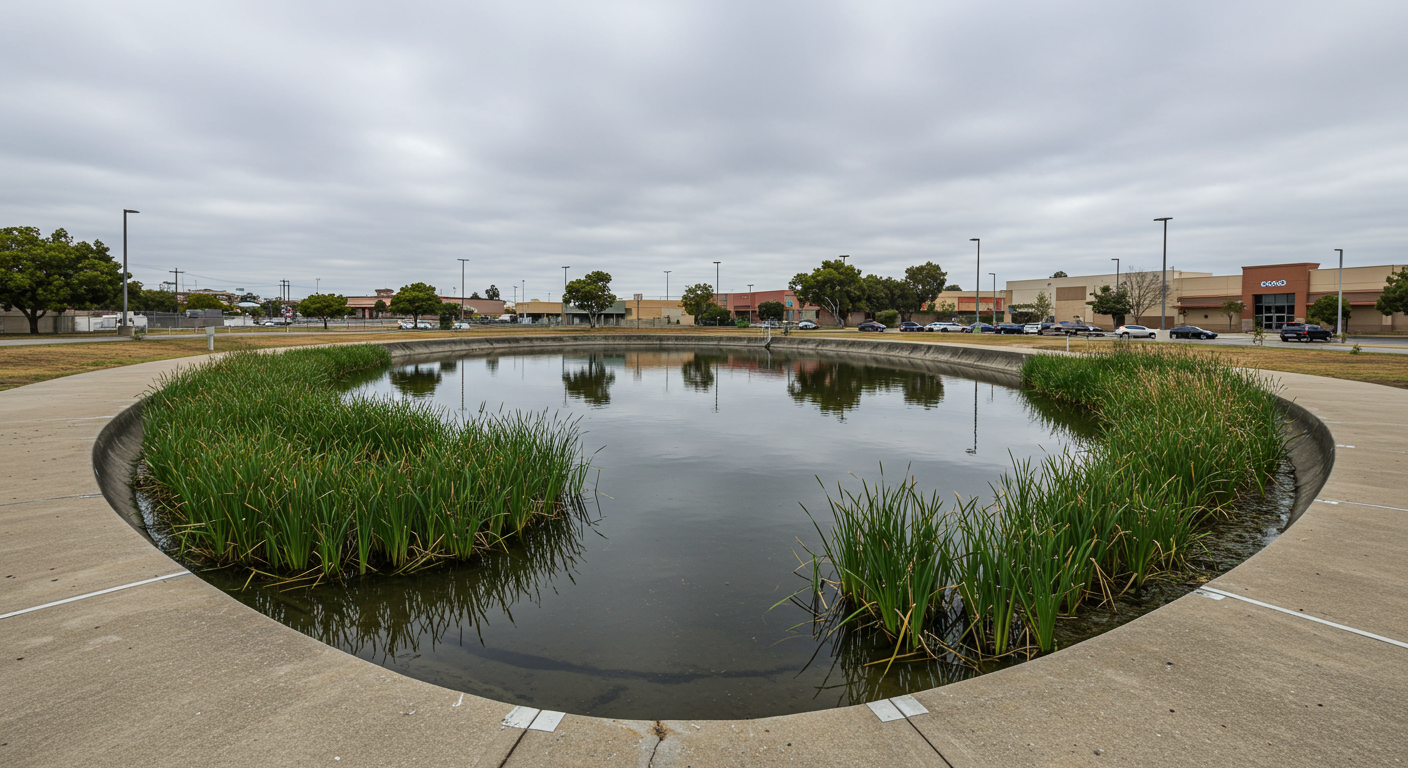
The design of retention basins creates near-ideal conditions for cattail colonization. Most basins are designed with gentle side slopes that create extensive shallow-water zones — exactly the habitat that Typha latifolia and hybrid cattail species prefer for rhizome establishment. Nutrient-rich stormwater input from surrounding developed land provides abundant phosphorus and nitrogen. Intermittent flooding cycles keep the basin margins moist throughout the growing season even in dry years.
In Southern California, the combination of warm winters, high ambient temperatures, and year-round urban runoff means that retention basins can support nearly continuous cattail growth activity. A basin that was largely clear in fall may develop substantial new growth by the following spring without any active management.
Property Types We Serve for Retention Basin Clearing
Our retention basin clearing service works across all sectors of basin ownership and management:
- HOA-managed community retention and detention basins
- Municipal stormwater detention infrastructure
- Commercial and industrial property stormwater basins
- Transportation corridor (highway and road) detention ponds
- Business park and office campus retention features
- Apartment and multifamily development retention ponds
- School district and institutional stormwater infrastructure
Our Retention Basin Clearing Process
Retention basin clearing follows a systematic process designed to maximize efficiency and minimize operational disruption to the basin's stormwater function.
Site assessment evaluates basin dimensions, current water level, existing vegetation density and distribution, inlet and outlet structure locations, and equipment access routes along the basin perimeter. We note any areas of standing water that require drawdown coordination or amphibious equipment.
Where basins can be partially or fully dewatered prior to work, we coordinate with the property manager or public works department on drawdown timing. Dry or low-water conditions dramatically improve equipment access and root extraction efficiency, reducing project time and cost.
Mechanical extraction proceeds along the basin margins, targeting the root mat layer in the sediment. We prioritize clearing around inlet and outlet structures first — restoring flow paths and access to operational components — then proceed to clear the remainder of the basin margin.
Extracted biomass is staged at approved locations within the basin or on adjacent upland areas, allowed to dewater, then hauled to composting or green waste disposal. We provide disposal documentation on request for permit compliance records.
Equipment Used in Retention Basin Operations
Long-reach excavators from stable basin bank positions handle the majority of retention basin clearing work throughout Southern California. Most engineered retention basins have vehicle-accessible perimeters — roads, service drives, or maintenance access corridors — that provide stable working platforms for shore-based equipment.
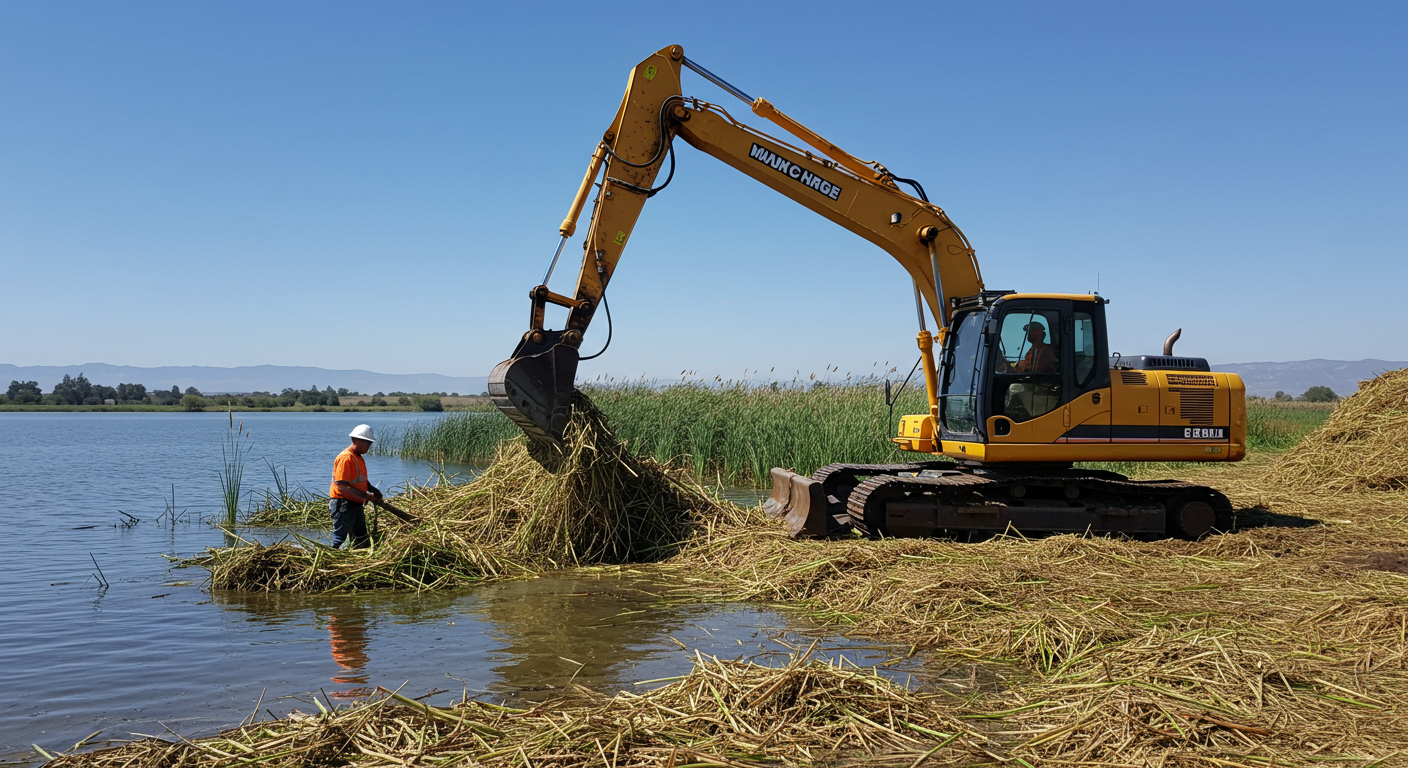
Professional mechanical extraction equipment deployed on California water bodies
For retention basins with soft or unstable banks, fully flooded conditions, or center-basin vegetation beyond reach of shore equipment, we deploy amphibious excavators directly into the water. These floating machines provide access to any point within the basin without requiring stable bank conditions.
Skid-steer attachments with root raking capability are used for cleaning up dewatered or dry basin floors after primary excavation, ensuring thorough root mass removal when basin drawdown is possible.
Project Planning Considerations for Basin Clearing
Coordination with operational schedules is the primary planning consideration for retention basin clearing. Most basins have legally mandated response times — basin volume must be restored after storm events, and maintenance windows must be scheduled around the rainy season. We work with property managers and public works departments to identify optimal scheduling windows.
Permit considerations vary by basin type and jurisdiction. Many engineered, privately-owned stormwater basins require only standard property access and do not trigger complex environmental permitting. However, any basin with connections to natural waterways or regulated channels may require coordination with Regional Water Quality Control Boards or other agencies. We advise on requirements during the site evaluation.
Ready for a free on-site evaluation?
Fixed-price quotes. No hourly billing. We serve all of California.
Contractor coordination may be required for large commercial or municipal projects where other contractors maintain other aspects of the basin. We coordinate directly with basin operators and property management teams.
Cost Factors for Retention Basin Clearing
Retention basin project costs are primarily driven by basin size, vegetation coverage percentage, and bank access conditions. Small to mid-size HOA retention basins — the most common project type in Southern California — typically range from two thousand to eight thousand dollars for moderate infestations with accessible perimeters. Larger commercial and municipal basins range from eight thousand to fifty thousand dollars depending on scale.
Basins that can be dewatered before work typically cost twenty to thirty percent less than equivalent flooded-basin projects because equipment efficiency and root extraction completeness both improve in dry or low-water conditions.
Environmental Considerations for Retention Basin Work
Before & After Results

Engineered retention basins typically offer fewer environmental restrictions than natural waterways because they are man-made infrastructure rather than regulated natural habitat. However, any basin with outflow to natural channels carries water quality considerations — we stage and haul all extracted biomass rather than leaving it in or adjacent to the basin where it could be washed back during storm events.
Our mechanical approach eliminates the chemical treatment restrictions, permit requirements, and post-treatment waiting periods that accompany aquatic herbicide use in stormwater infrastructure.
Long-Term Basin Management
Retention basins under ongoing management programs typically require clearing every two to four years, depending on nutrient loading from the surrounding watershed and the thoroughness of the initial root extraction. We recommend an annual inspection after initial treatment to monitor regrowth rates and address any regeneration before it becomes a full re-treatment project.
For HOA boards and commercial property managers responsible for multiple basins, we offer portfolio-level maintenance agreements that provide scheduled annual assessments, documentation for compliance reporting, and preferential scheduling for clearing work.
Our Inspection and Proposal Process
Contact us to schedule a free on-site retention basin evaluation. We review aerial imagery, assess basin dimensions and vegetation extent, evaluate access conditions, and note any regulatory considerations for your specific basin. A written fixed-price proposal is provided within twenty-four to forty-eight hours. We work with HOA boards, property management companies, municipalities, and commercial property teams throughout Southern California.
Frequently Asked Questions
Does our HOA retention basin need a permit to remove cattails?
Can you clear our retention basin without fully dewatering it?
How do we document the work for our stormwater compliance records?
What is the typical timeline from evaluation to project completion?
What cities in Orange County and Los Angeles County do you serve?
Key Service Areas
Our crews are active throughout California. Below are cities, counties, and regional hubs closely served for this service.
Counties
Regional Hub
Southern California Cattail Removal Hub →Related Authority Guides
Ready to solve your cattail problem?
Get a free on-site evaluation and written fixed-price proposal. We serve all of California.
Our Cattail Removal Services
Professional mechanical removal for every California water body type:
Related California Cattail Removal Resources
Further reading on related services, costs, permits, and management strategies for California property owners.
- Stormwater Basin Vegetation Compliance
How overgrown retention basins create MS4 permit violations and HOA liability — and how to resolve them.
- Retention Basin Removal Cost
Per-project cost ranges for HOA and municipal basin clearing across California.
- Mechanical Cattail Removal
The root extraction method used in all California retention basin projects for lasting results.
- California Permit Considerations
When HOA ponds and stormwater basins require regulatory coordination — and when they typically don't.
- Pond Cattail Removal
Similar extraction services for private ponds, farm ponds, and golf course water features.
- Long-Term Management Plan
Multi-year maintenance programs that keep California retention basins clear and MS4-compliant.
- When Cattails Become a Problem
Six warning signs that indicate a retention basin needs professional intervention.
- Stormwater Basin Cattail Maintenance
Scheduled annual clearing programs for California HOA and municipal basins — compliance records included with every project.
- Cattails and Mosquito Control
How dense stands in retention basins create Culex and Aedes breeding zones that standard larvicide programs cannot adequately penetrate.
- Cattail Removal for Vector Control
How vector control districts coordinate with California basin operators to reduce mosquito habitat in stormwater infrastructure.
- Cattail Disposal and Haul-Off
What happens to extracted biomass after basin clearing — haul routes, composting options, and how disposal logistics affect California project costs.
California Cities We Serve
Select your city for local pricing and scheduling:
- Los Angeles
- San Diego
- San Jose
- San Francisco
- Sacramento
- Fresno
- Oakland
- Long Beach
- Bakersfield
- Anaheim
- Santa Ana
- Riverside
- Stockton
- Irvine
- Modesto
- Costa Mesa
- Orange
- Huntington Beach
- Santa Barbara
- Ventura
- Santa Rosa
- Salinas
- Chula Vista
- Berkeley
- Pleasanton
- Walnut Creek
- San Mateo
- Palo Alto
- Visalia
- Mission Viejo
- Glendale
- Pasadena
- Torrance
- Pomona
- Corona
- Fontana
- Rancho Cucamonga
- Ontario
- Oceanside
- Escondido
- Carlsbad
- Temecula
- Murrieta
- Victorville
- Burbank
- Fremont
- Hayward
- Concord
- Richmond
- Antioch
- Daly City
- San Leandro
- Redwood City
- Milpitas
- Mountain View
- Sunnyvale
- Santa Clara
- Merced
- Turlock
- Tracy
California Lakes, Deltas & Water Bodies
We serve named water bodies throughout California, including lakes, reservoirs, delta channels, and wetland systems: