Professional Service
Lake Edge Clearing
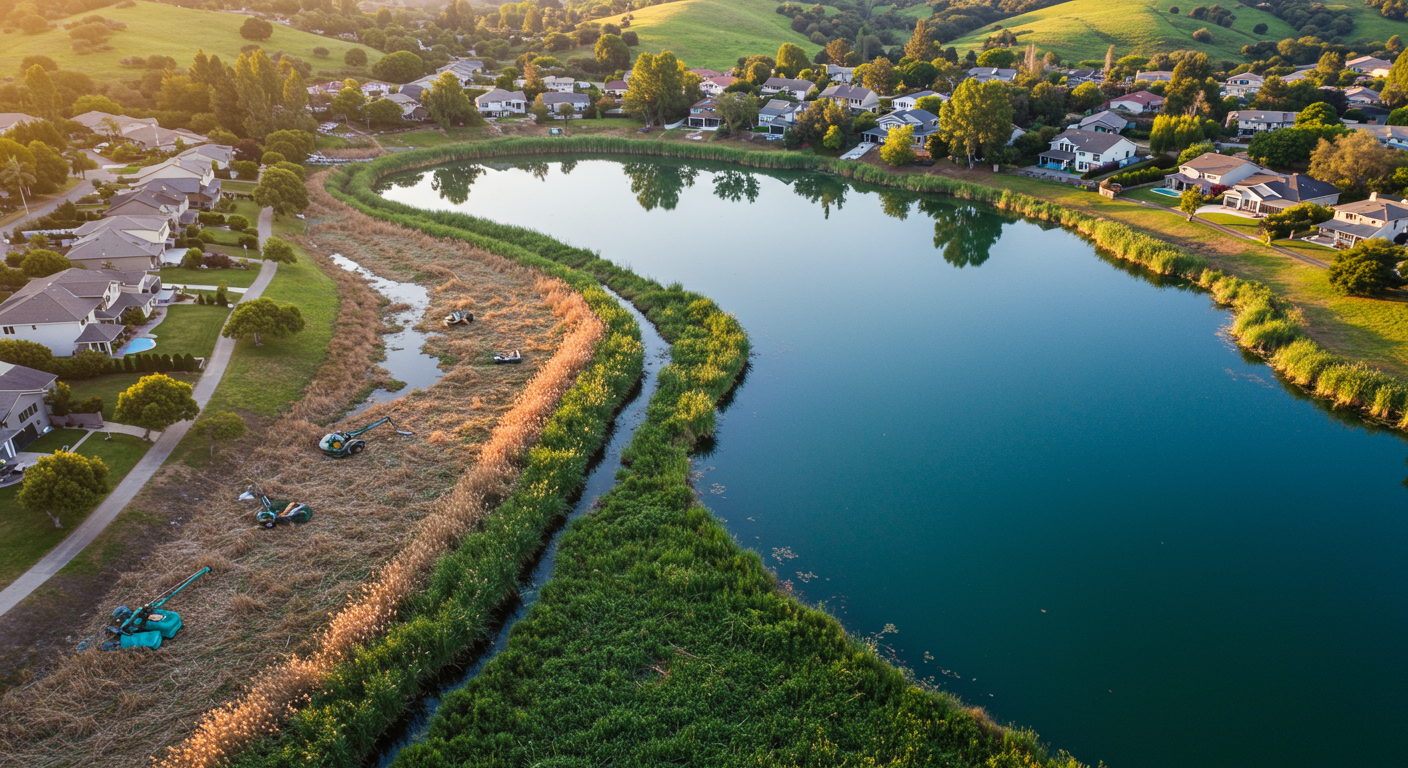
Lake edge clearing and cattail removal across California — mechanical extraction for HOA community lakes, natural lakes, reservoir shorelines, lake association properties, and golf course water features.
Lakes present the most complex cattail removal challenge in California — and also the highest-stakes one. HOA community lakes are often the focal amenity of a master-planned development, directly tied to property values and resident satisfaction. Natural lakes and reservoirs serve recreational, ecological, and water supply functions that are jeopardized when cattail stands consume the shallow shoreline zone. Golf course water hazards become playability problems. Estate lakes lose their visual and recreational appeal. In every case, the challenge is the same: a perennial, rhizome-spreading plant that grows faster than most vegetation management programs can respond to it.
Lake edge clearing addresses the shoreline zone where cattails are most destructive — the shallow-water margins where the plant's rhizomes can reach the sediment, establish root mass, and advance season over season. Without active management, the vegetated margin advances into the open water year after year. A lake that was half open water a decade ago may be substantially consumed by cattail stands today, reducing usable surface area, degrading water quality, and eliminating access to what were once recreational shoreline areas.
Why Lake Shorelines Are the Critical Intervention Point
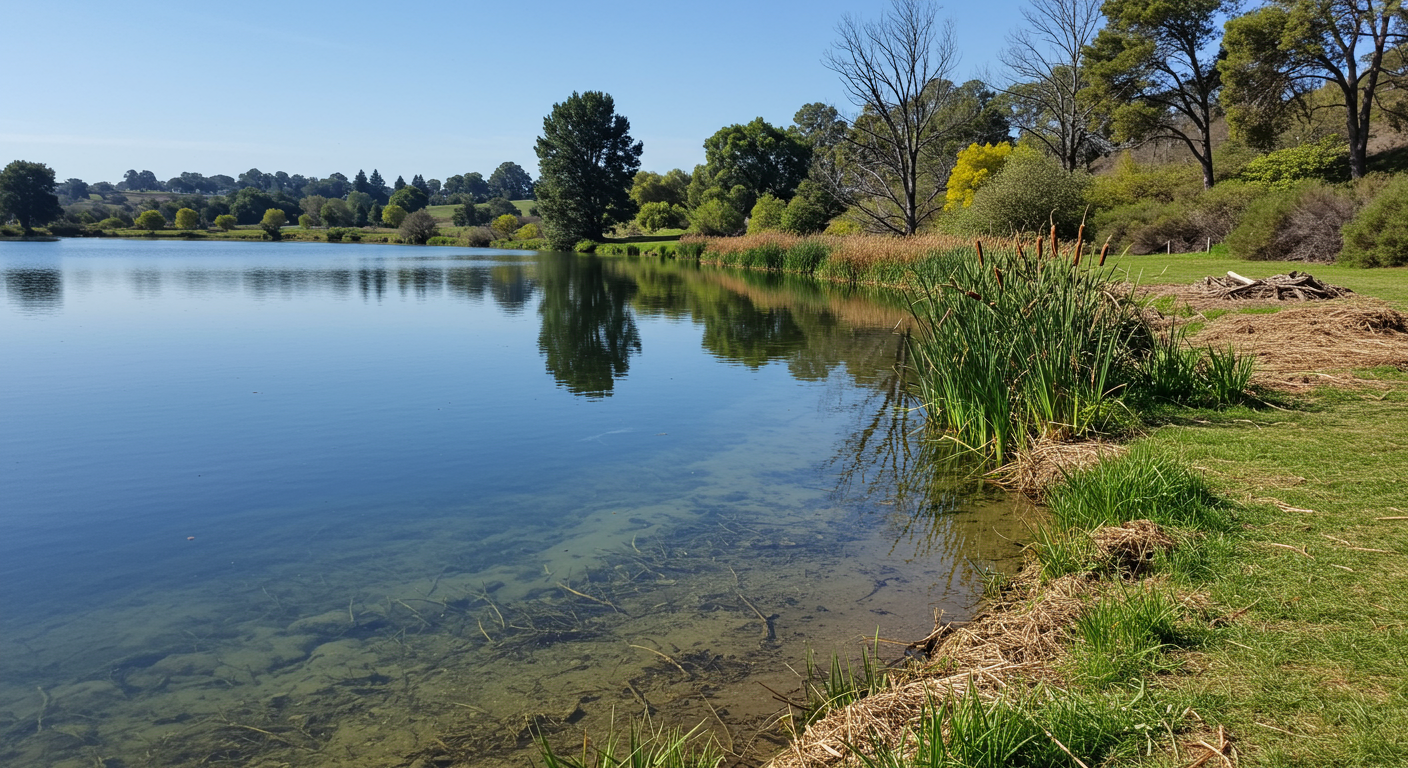
Lake cattail management is most effective when focused on the shoreline zone rather than attempting to address all vegetation simultaneously. The shoreline is where new establishment occurs, where rhizomes advance into previously open water, and where the plant has the most direct impact on recreational use and visual appearance. Clearing the shoreline zone and establishing a clear buffer between open water and any remaining upland vegetation is the foundation of any effective lake management program.
Established root mats along lake margins also function as growing platforms that elevate the vegetated zone above the water surface over time — a process that converts what was originally open water into what effectively becomes dry land as the root mat accumulates dead material and colonizes the shallow sediment. This process can only be reversed by physically removing the root mass, not by cutting or surface treatment.
Property Types We Serve for Lake Edge Clearing
Our lake edge clearing services address the full range of California lake property types:
- HOA community lakes and master-planned development amenity lakes
- Private estate lakes and residential waterfront properties
- Golf course water hazards and aesthetic lake features
- Municipal parks and recreation department lakes
- Regional park and county open space lakes
- Natural lakes with maintained recreational shoreline access
- Reservoir shoreline zones managed for recreation or habitat
Our Lake Edge Clearing Process
A lake clearing project begins with an aerial and on-foot assessment of the shoreline perimeter. We map the extent of vegetation, identify access points for equipment deployment, evaluate bank conditions, and assess water depth through the vegetated zone. For large lakes or those requiring amphibious equipment, we also evaluate launch ramp access and water navigation routes.
Shore-based long-reach excavators handle most lake edge clearing projects where the vegetation is within forty to sixty feet of an accessible bank. The long arm reaches over the water, driving the bucket into the sediment to extract root masses in sections that are deposited on the bank for dewatering and disposal.
For large lakes where vegetation extends beyond reach of shore-based equipment, or where the bank is too soft or steep to support conventional machinery, our amphibious excavator is deployed directly into the lake. Operating from the water, it accesses any shoreline zone without requiring stable bank conditions and without requiring the machine to touch the lake bottom.
Equipment Deployed for Lake Clearing Operations
Lake edge clearing leverages specialized equipment configurations that allow us to work effectively from either the shore or the water:
High-reach shore excavators with extended forty to sixty-foot arms provide cost-effective clearance of vegetation within reach of stable bank positions. These machines offer full root extraction capability and are the standard solution for accessible lake edges.
Amphibious pontoon excavators float on the lake surface, providing unlimited access to any shoreline zone regardless of bank conditions, water depth, or the extent of the vegetated area. Essential for large lakes, difficult banks, and deep-water situations.
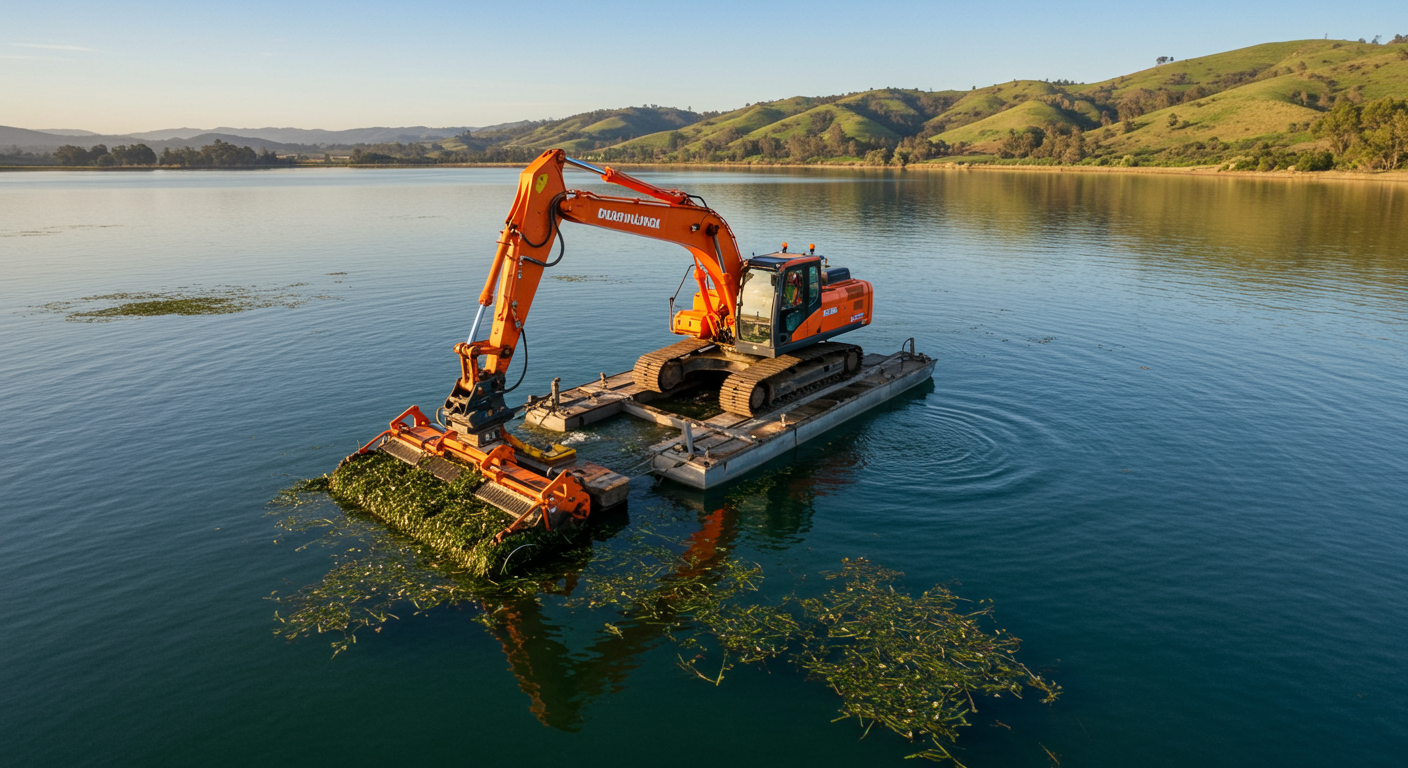
Professional mechanical extraction equipment deployed on California water bodies
Barge-and-crane configurations may be used for very large lake clearing projects, transporting excavated biomass by water to bank-side staging areas when hauling by vehicle is not practical.
Project Planning Considerations for Lake Clearing
Lake clearing projects involve several planning considerations beyond standard pond work:
Shoreline length and priority zones — most lake properties have sections of shoreline with higher management priority (recreational areas, dock areas, visible from residences) and lower priority areas. We work with property owners to prioritize clearing zones and phase work to stay within budget.
Access and staging — lake clearing projects generate significant volumes of wet biomass. We identify staging areas on the bank where extracted material can dewater before hauling, and plan equipment access routes that minimize site disturbance.
Ready for a free on-site evaluation?
Fixed-price quotes. No hourly billing. We serve all of California.
Adjacent habitat sensitivity — some lake shorelines border or contain native habitat areas that require avoidance or special handling. We identify these during the evaluation and plan work accordingly.
Regulatory coordination — natural lakes and reservoirs in California may require coordination with state and federal agencies. We advise on permit needs during the site evaluation.
Cost Factors for Lake Edge Clearing
Lake clearing project costs depend primarily on the total length of shoreline to be cleared, the density of the root mat, and whether shore-based or amphibious equipment is required. Amphibious operations add twenty to forty percent to project costs compared to equivalent shore-based work. Large-scale projects benefit from mobilization cost efficiencies — the fixed cost of bringing equipment to the site is spread across more linear feet of clearing, reducing the effective cost per foot.
Lake clearing projects are priced at $25,000 to $100,000 per acre depending on water depth, vegetation density, and disposal requirements. Disposal logistics — particularly biomass haul-off distance and facility fees — are the primary variable that drives cost within this range.
Environmental Considerations for Lake Projects
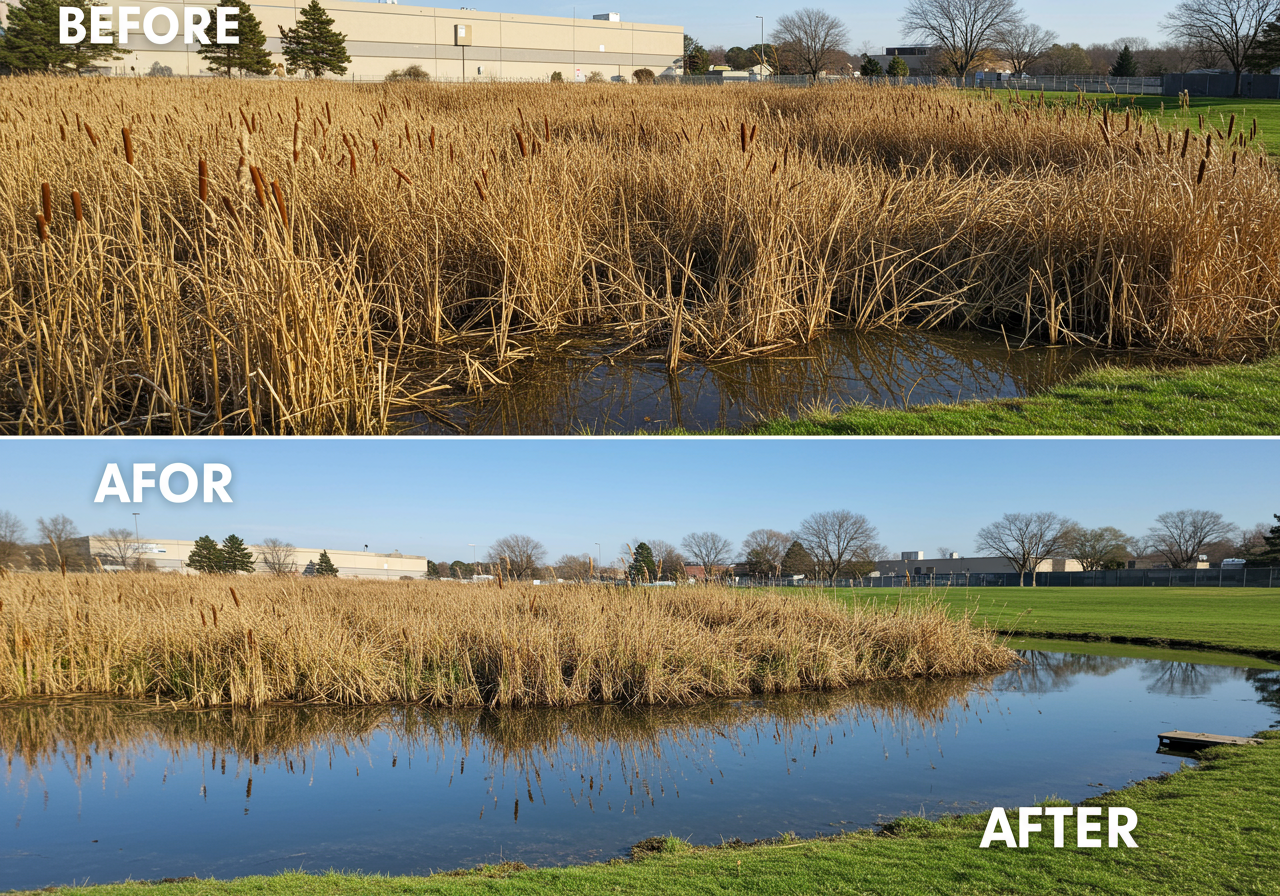
Before & After Results
California natural lakes may have significant wildlife habitat value that requires consideration during planning. We evaluate the presence of nesting bird species, fish spawning areas, and adjacent wetland habitats as part of the site assessment. Work is scheduled to avoid sensitive periods where applicable, and we comply with all applicable California Department of Fish and Wildlife requirements.
Mechanical extraction in lakes creates temporary turbidity that typically clears within twenty-four to seventy-two hours. In larger water bodies with greater volume, this period may be shorter. No chemical treatments are used in any of our lake clearing work.
Long-Term Lake Management Strategies
Lake edge management is an ongoing process, not a one-time event. Even after thorough root extraction, lake shorelines will experience ongoing seed input from wind-dispersed cattail seeds and potential rhizome regeneration from any remaining root fragments. A long-term strategy that includes the initial comprehensive removal followed by annual or biannual monitoring and early-intervention maintenance provides the most cost-effective path to maintaining clear, attractive shoreline over the years.
We offer ongoing maintenance agreements for HOA and property management clients that provide scheduled annual assessments and priority scheduling for any needed follow-up work.
Our Inspection Process for Lake Properties
Contact us by phone or through the online request form to initiate a free evaluation. For lake properties, we typically review aerial imagery before the site visit to understand the extent of vegetation and plan the most efficient assessment route. The on-site evaluation includes a full perimeter walk, water depth probing in vegetated zones, bank stability assessment, and a discussion of your priorities and timeline. A written proposal follows within twenty-four to forty-eight hours.
Frequently Asked Questions
How much shoreline can you clear per day?
Do you offer ongoing lake maintenance contracts?
Can you clear cattails from a lake that has a fishing program or stocked fish?
What Southern California lake communities do you serve?
Is a permit required to clear a lake in Southern California?
Key Service Areas
Our crews are active throughout California. Below are cities, counties, and regional hubs closely served for this service.
Counties
Regional Hub
Southern California Cattail Removal Hub →Related Authority Guides
Ready to solve your cattail problem?
Get a free on-site evaluation and written fixed-price proposal. We serve all of California.
Our Cattail Removal Services
Professional mechanical removal for every California water body type:
Related California Cattail Removal Resources
Further reading on related services, costs, permits, and management strategies for California property owners.
- Pond Cattail Removal
Similar mechanical extraction services for private ponds, farm ponds, and HOA water features.
- Mechanical Cattail Removal
Shore-based and amphibious excavation techniques used across California lake and shoreline projects.
- Amphibious Excavator Removal
When lake center vegetation or soft-bank conditions require waterborne equipment access.
- Lake Shoreline Clearing Cost
Per-linear-foot cost factors for California lake edge clearing and restoration projects.
- California Wetland Vegetation Permits
CDFW, Army Corps, and RWQCB permit requirements for work on natural California lakes.
- Habitat Restoration After Removal
Native plant establishment to stabilize cleared lake banks and suppress long-term regrowth.
- Cattail Regrowth Prevention
Long-term management strategies to keep California lake shorelines clear after removal.
California Cities We Serve
Select your city for local pricing and scheduling:
- Los Angeles
- San Diego
- San Jose
- San Francisco
- Sacramento
- Fresno
- Oakland
- Long Beach
- Bakersfield
- Anaheim
- Santa Ana
- Riverside
- Stockton
- Irvine
- Modesto
- Costa Mesa
- Orange
- Huntington Beach
- Santa Barbara
- Ventura
- Santa Rosa
- Salinas
- Chula Vista
- Berkeley
- Pleasanton
- Walnut Creek
- San Mateo
- Palo Alto
- Visalia
- Mission Viejo
- Glendale
- Pasadena
- Torrance
- Pomona
- Corona
- Fontana
- Rancho Cucamonga
- Ontario
- Oceanside
- Escondido
- Carlsbad
- Temecula
- Murrieta
- Victorville
- Burbank
- Fremont
- Hayward
- Concord
- Richmond
- Antioch
- Daly City
- San Leandro
- Redwood City
- Milpitas
- Mountain View
- Sunnyvale
- Santa Clara
- Merced
- Turlock
- Tracy
California Lakes, Deltas & Water Bodies
We serve named water bodies throughout California, including lakes, reservoirs, delta channels, and wetland systems: