Professional Service
Shoreline Vegetation Clearing
Learn about shoreline vegetation clearing from California's professional cattail removal experts. Free site evaluations — call (707) 242-7021.
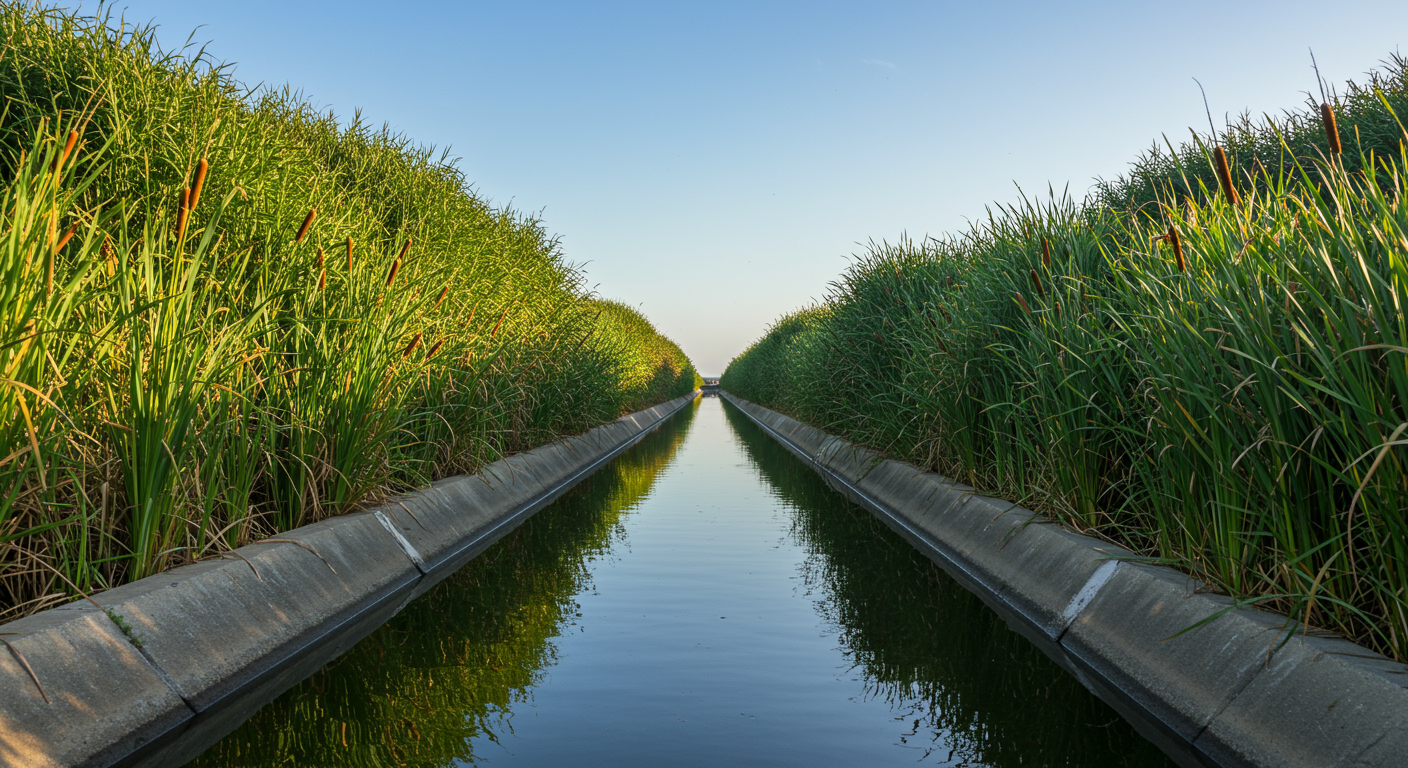
California's rivers, creeks, drainage channels, and coastal waterways host some of the most challenging cattail infestations in the state. Unlike ponds and retention basins — where the water body is enclosed and the vegetation zone is contained within a defined perimeter — shoreline environments present a continuous linear challenge. Cattails advance along the bank in both directions from any establishment point, with rhizomes threading through the bank soil and root mats extending into the water. Left unmanaged over multiple seasons, a shoreline transitions from open, accessible waterway to a vegetation-choked channel where water flow is impeded, bank access is blocked, and the ecological function of the waterway is compromised.
Shoreline cattail clearing is technically demanding in ways that basin and pond work is not. Banks range from hard-packed clay to soft, saturated soil that cannot support heavy equipment without specialized setup. Steep or unstable banks introduce erosion risk if removal is not done carefully. Many California waterway shorelines are subject to regulatory oversight from multiple agencies — the California Department of Fish and Wildlife, Regional Water Quality Control Boards, and the Army Corps of Engineers all have jurisdiction over different aspects of work in or adjacent to waterways. Understanding and navigating these requirements is part of our shoreline service.
Why Shoreline Cattails Are Uniquely Destructive
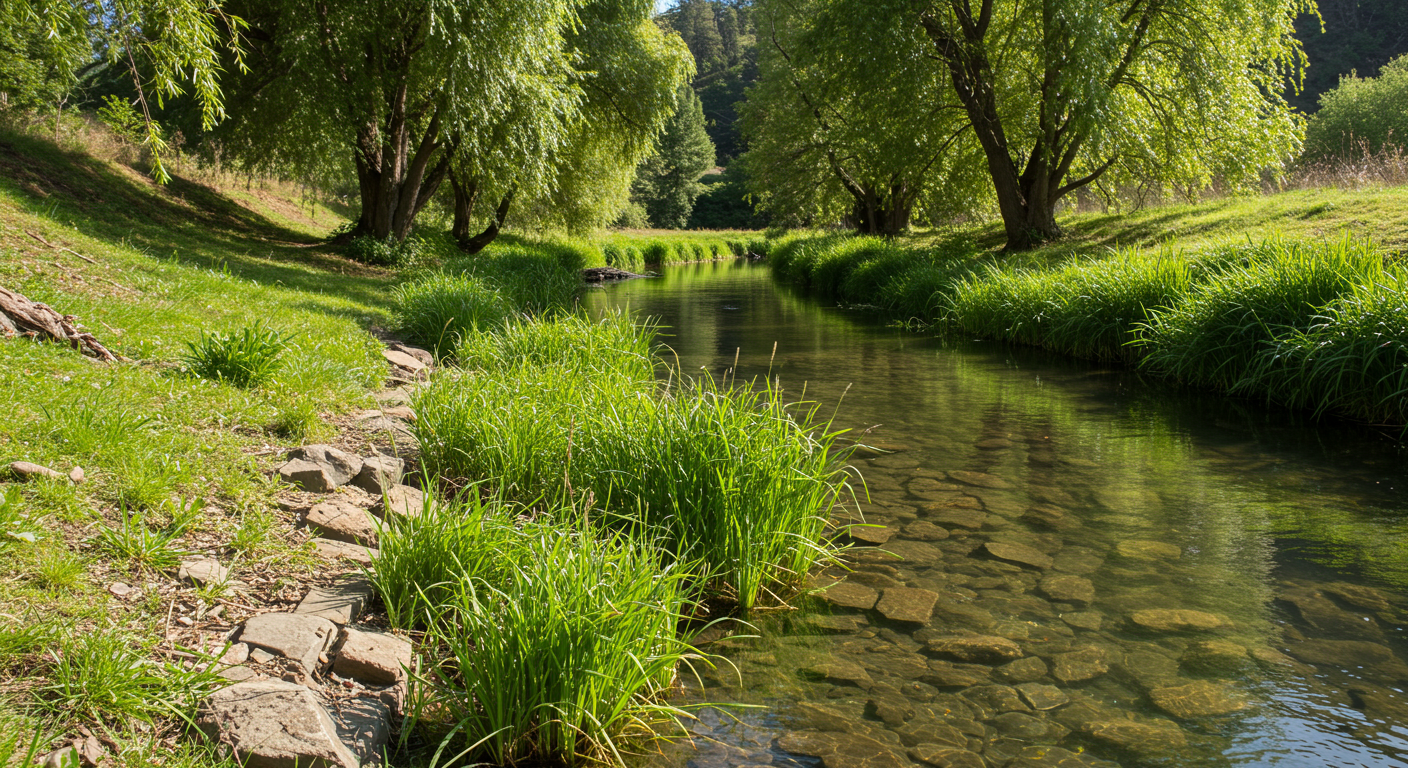
Shoreline cattails do more than block access and reduce water quality — they actively destabilize the bank soil structure over time. The root mat creates a dense, tangled layer in the upper bank soil that, paradoxically, both holds the bank in place and transforms the bank's character. As the root mat thickens and raises the shoreline zone above the natural water surface, it creates conditions where the bank area converts from wetland edge to elevated, dry ground — a process that permanently reduces channel width over decades.
Additionally, dense shoreline cattail stands trap sediment and debris in the water column, reducing flow capacity and increasing flood risk in managed channels and drainage systems. The stagnant water trapped within the stands provides ideal mosquito breeding conditions — a recurring concern along California's Central Coast and Bay Area corridors where public health agencies actively monitor Aedes and Culex populations.
Property Types We Serve for Shoreline Clearing
Our shoreline vegetation clearing services address the full range of California waterway types:
- Private creekside and riverfront residential and agricultural properties
- Municipal drainage channels and flood control infrastructure
- Coastal lagoon and estuarine shoreline management zones
- Irrigation canal and agricultural channel banks
- Riparian corridor restoration and habitat management areas
- Highway and transportation corridor drainage channels
- Ranch and ranch road stream crossings
Our Shoreline Removal Process
Shoreline clearing projects begin with a linear assessment of the waterway segment targeted for clearing. We walk both accessible banks, assess vegetation density and coverage, probe sediment depth and bank stability, evaluate equipment access points, and identify any sensitive habitats or regulatory conditions relevant to the work.
Equipment selection for shoreline work depends critically on bank conditions. Where banks are stable and accessible with solid vehicle routes, shore-based long-reach excavators work from the bank without entering the water. Where banks are soft, wet, or inaccessible, we deploy amphibious equipment from the water side — avoiding direct bank disturbance and reducing erosion risk.
Root extraction targets the rhizome layer in the bank soil and adjacent submerged sediment. Cattail rhizomes in bank environments can extend deeper than those in pond or basin sediments, sometimes reaching twenty-four to thirty-six inches in developed bank soils. Thorough root extraction requires driving the excavator bucket to the full depth of the root system — and is the key difference between lasting results and rapid regrowth.
Post-extraction, we advise on native plant establishment for the cleared bank zone. Willow, native rush, and sedge species appropriate to your specific waterway type can be established to occupy the cleared niche and reduce the speed of cattail recolonization. Many shoreline management programs combine mechanical removal with native revegetation as a comprehensive restoration approach.
Equipment Used for Shoreline Work
Long-reach shore excavators with extended boom arms reach across the bank margin and into the water to extract root masses from stable bank positions. This is the preferred configuration for accessible, stable-bank situations because it avoids direct water entry and minimizes site disturbance.
Amphibious excavators on pontoon floats are used where bank conditions do not support conventional equipment — soft or saturated banks, steep canyon walls, or situations where bank disturbance must be minimized to protect existing vegetation. The amphibious machine accesses the vegetation from the water side, reducing bank impact.
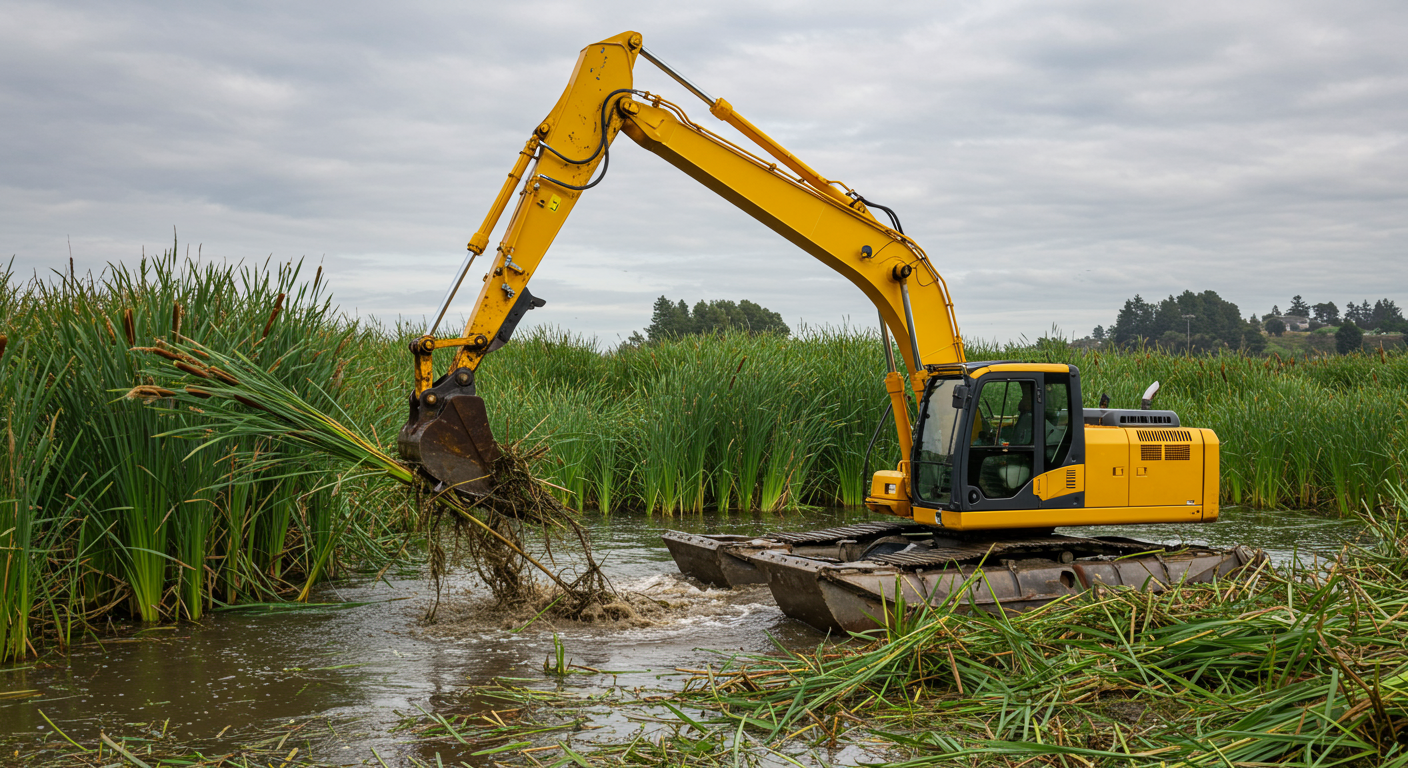
Professional mechanical extraction equipment deployed on California water bodies
Hydraulic thumb and root rake bucket attachments improve root mat extraction efficiency in difficult substrates, particularly in sandy or mixed-sediment bank environments common along California coastal waterways.
Project Planning Considerations for Shoreline Work
Regulatory coordination is the most significant planning consideration for California shoreline projects. Work within the ordinary high water mark of any natural waterway in California is subject to oversight from multiple state and federal agencies. Requirements vary significantly based on waterway type, specific location, and the presence of sensitive species or habitat.
We advise clients on applicable permit requirements during the site evaluation and provide guidance on the coordination process. For waterways where permits are required, we can provide project documentation — site assessment, vegetation survey, proposed work description — to support permit applications.
Timing and seasonal restrictions may apply to protect nesting species, fish migration periods, or seasonal flow conditions. Central Coast waterways in particular have specific timing windows for work during low-flow summer months.
Ready for a free on-site evaluation?
Fixed-price quotes. No hourly billing. We serve all of California.
Cost Factors for Shoreline Clearing
Shoreline clearing projects are priced based on the total area cleared and disposal requirements, typically falling in the $25,000 to $100,000 per acre range. Projects requiring amphibious equipment or regulatory coordination are toward the upper end of this range.
Setup and mobilization costs are a meaningful component of shoreline project cost, particularly for remote or rural waterway sites. Projects with a minimum of three hundred to five hundred linear feet of clearing are most cost-effective given fixed mobilization costs.
Environmental Considerations for Shoreline Projects
Shoreline projects occur at the interface between terrestrial and aquatic environments — the most ecologically sensitive zone in most waterway systems. We approach shoreline work with careful attention to minimizing disturbance beyond the vegetation zone, avoiding sensitive bank habitats, and timing work to avoid sensitive wildlife periods.
All extracted biomass is removed from the waterway corridor and disposed of at approved facilities. We do not leave root material in or immediately adjacent to the water where it could be re-transported by flow events.
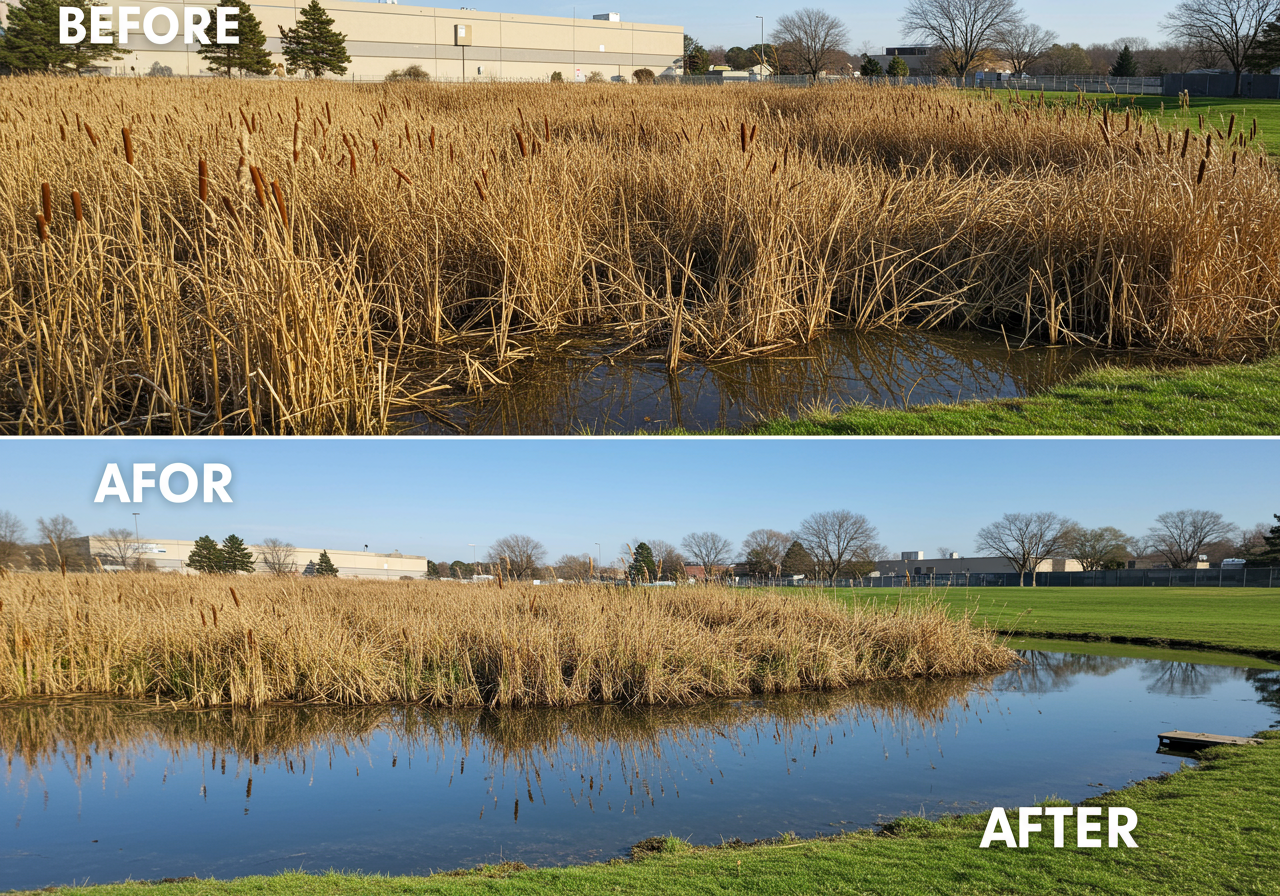
Before & After Results
Long-Term Shoreline Management Strategies
California shorelines subject to ongoing seed input from upstream or adjacent cattail populations require active long-term management to maintain clearance. Our recommended approach combines a thorough initial mechanical removal with:
Annual monitoring to identify new seedling establishment or rhizome regeneration before it becomes established growth. Seedlings and early-stage regrowth are far less expensive to address than re-established stands.
Native plant buffer establishment in the cleared zone to compete actively with cattail recolonization. Working with a native plant nursery to select species appropriate to your specific waterway type and hydrology is a worthwhile investment.
Watershed management — where feasible, addressing upstream sources of seed or root material reduces ongoing recolonization pressure on the cleared site.
Our Inspection Process for Shoreline Properties
Contact us with your property's waterway location, approximate length of the affected area, and access conditions. We schedule a free on-site evaluation, walk the waterway segment with you, assess vegetation and bank conditions, review any regulatory considerations, and provide a written proposal within twenty-four to forty-eight hours. For larger linear clearing projects, we may request aerial imagery review prior to the site visit to optimize assessment planning.
Frequently Asked Questions
Do I need a permit to remove cattails from my creek bank in California?
Can shoreline clearing be done without damaging the bank?
How long does it take for cattails to return after shoreline clearing?
What Central Coast cities do you serve?
Can you clear both banks of a creek simultaneously?
Key Service Areas
Our crews are active throughout California. Below are cities, counties, and regional hubs closely served for this service.
Regional Hub
Central Coast Cattail Removal Hub →Related Authority Guides
Ready to solve your cattail problem?
Get a free on-site evaluation and written fixed-price proposal. We serve all of California.
Our Cattail Removal Services
Professional mechanical removal for every California water body type:
Related California Cattail Removal Resources
Further reading on related services, costs, permits, and management strategies for California property owners.
California Cities We Serve
Select your city for local pricing and scheduling:
- Los Angeles
- San Diego
- San Jose
- San Francisco
- Sacramento
- Fresno
- Oakland
- Long Beach
- Bakersfield
- Anaheim
- Santa Ana
- Riverside
- Stockton
- Irvine
- Modesto
- Costa Mesa
- Orange
- Huntington Beach
- Santa Barbara
- Ventura
- Santa Rosa
- Salinas
- Chula Vista
- Berkeley
- Pleasanton
- Walnut Creek
- San Mateo
- Palo Alto
- Visalia
- Mission Viejo
- Glendale
- Pasadena
- Torrance
- Pomona
- Corona
- Fontana
- Rancho Cucamonga
- Ontario
- Oceanside
- Escondido
- Carlsbad
- Temecula
- Murrieta
- Victorville
- Burbank
- Fremont
- Hayward
- Concord
- Richmond
- Antioch
- Daly City
- San Leandro
- Redwood City
- Milpitas
- Mountain View
- Sunnyvale
- Santa Clara
- Merced
- Turlock
- Tracy
California Lakes, Deltas & Water Bodies
We serve named water bodies throughout California, including lakes, reservoirs, delta channels, and wetland systems: